Saturday, 4 January 2014

The Widow's Might

It was only a few days after meeting Mrs Beauregard that a notice appeared in the newspaper, detailing a sale by auction of effects by Messrs Ripov and Scarper. I almost choked on my coffee when I read the address.


I grabbed the thickest pencil I could find, drew a circle around the advertisement, and for emphasis, added an exclamation mark before whisking the whole lot up in the Lamson.

I was fully prepared for Mr Whybrow’s – not so much an entrance, more an explosion into the back office.  For a moment, he gaped at me, thunderstruck. Then he blurted, “Mrs Beauregard’s popped her clogs!”

“Yes, sir.”  Then I noticed the slightly wild look to his eyes. The shock had penetrated to the core of his being. “Do you think she was just waiting for her ring to be found?”


Mr Whybrow shook his head to jolt his gears back into place. “It does happen that way. I’ve never actually met the lady.”  He scanned the newsprint; it was probably the first time he’d taken it in properly since he’d fallen flat at the revelation. “Sideboard, dining table – would you have said that the house was particularly lavishly furnished?”

“It was good quality furniture, sir, but nothing really stood out. Just the astronomical clock that’s listed there.”

“Yes, you hadn’t mentioned that before.”  He looked at me sharply, curiously. “How much did you observe about that clock, Miss Bluebird?”

I could only splutter. “It had the usual face, but with funny signs around it, and little balls that went round. It was all in horrible marble; it didn’t really belong in that house.”

Mr Whybrow rubbed his chin and mused, h’mming to himself. “Not really a fair question to ask you; clocks aren’t really our metier. But astronomical clocks haven’t been popular in this country for a long time, except huge things in churches. I wonder if it’d be worth taking a shufti.”

“Sir?”  Something had obviously clicked in his imagination. “You’d better take a whatever-it-is quickly, sir. The auction starts in an hour.”

“Good Lord, you’re right! Let’s fire up the Dreadnought, Miss Bluebird. This time you can snuggle up in the sidecar.”

It was nice to be able to keep my skirts on for a change. I waited until we were under way before I asked, “Sir – you’ll have to pardon my ignorance, but are astronomical clocks valuable?”

Without looking round, he called back over the engine’s roar. “Potentially, very much so. Didn’t you notice that the disposal is taking place at her house? They’re not even investing in auction room space. There’s every chance that they don’t even know what they’ve got, there.”


Potentially very much so. I could well understand his enthusiasm. Most of the newspaper’s readership wouldn’t know that, either.

I was a little alarmed at the speed with which he took the straight sections, but understood his need for haste. We arrived at the late Mrs Beauregard’s house in good time; I’d warned Mr Whybrow that the house was not in the best of repair, but if he was in any way put off by its first appearance, he kept it to himself. The knowledge that its lonely tenant had died added a deeper tragedy to the house. It might not have looked much, but it had been a haven for Mrs Beauregard for many years.

Mr Whybrow clearly knew what he was about, I was content to follow him inside and take his lead. He checked his fobwatch; we still had half an hour left. My first impression of the house was that it had been violated, but then I was probably the only one present who had known its occupant. The furniture had all been rearranged; the Sheriff’s declaration had gone, as had any family pictures or anything which might have suggested that a person had lived there. This was a small, temporary shop that was spending its short life in a single bankrupt sale of stock.

Only a couple of nondescript individuals were nosing around; I recognised the type as those who ran the seedy second-hand shops to be found in London’s back streets in the Seven Dials area. One man stood by himself at the dining table, meticulously lining up ledgers, ink bottle, ruler and all the other paraphernalia of the auctioneer, but Mr Whybrow made a beeline for the astronomical clock which stood on its sideboard, evidently disdained by his competitors as too unusual for any customers that they were likely to attract.


The clock seemed to be as Mr Whybrow had expected to find it. Gingerly, he turned it round, and opened up the back. For a minute or so, he peered inside without touching anything, mmh’ming to himself.

The auctioneer suddenly appeared at his elbow; his nose reminded me of one of those awkwardly-shaped workhouse potatoes that nobody wanted to peel as it’d involve a lot of peeling for very little potato at the end. His horrible nasal weaselly voice made me shudder. “Would you mind not tinkering with the merchandise, sir? It has to be in good working order at time of sale.”

Mr Whybrow gave him a look that was just on the soft side of stern. “And you are?”

“Samuel Scarper, of Ripov and Scarper, sir.” Mr Scarper beamed, displaying teeth that reminded me of a gin trap.

“Alastair Whybrow, jeweller. My card.”  Mr Whybrow handed over the said article. “And I can tell you that this item isn’t in good working order. In fact, it’s not working at all. I hope you bore that in mind when you set the reserve price?”


Mr Scarper’s face fell. Of course, he’d been hoping to get away with foisting the defunct monstrosity on some unsuspecting bidder. He deflated a little further, recognising that he would not be able to fool Mr Whybrow. “Yes, sir. Are you interested in the clock yourself?”

“Mmmm – mainly for the case. The action’s had it; too little maintenance to be worth saving. But I might be able to replace it with a modern action and flog it on as a curio.”

Which, to Mr Scarper’s mind, meant that he’d get a pittance for the clock, or nothing at all, so he might as well adjust his reserve price accordingly. But he was not beaten yet. He knew Mrs Beauregard’s effects wouldn’t fetch much, so he might as well make an effort.  “Well, the problem with auctions is that nobody knows how much something will fetch until it’s actually been sold. And it looks as if we’re about ready to begin.”  He swept his eyes over the room, and nobody else had arrived. There wouldn’t be much in the way of competition. But to make sure, he checked his watch. “If Sir and Madam would like to take their places?”

Madam. I liked that!

Mr Whybrow bit his tongue as he ushered us to a pair of armchairs. He leaned across to me and without moving his mouth, growled,  “Whatever you do, don’t move a muscle or say a word. He’ll interpret it as a bid.”

I caught myself about to nod. “Very good, sir,”  I muttered from the corner of my mouth.

As we’d expected, the others there were hoping to pick up what was fairly nondescript for an equally nondescript price. I followed Mr Whybrow’s lead, and did my best to exhibit no interest whatsoever as one item after another fell before the hammer, although some didn’t fall at any price. Then we reached the clock.

Mr Scarper, as the only excited person in the room, beamed at each of us in turn. He reminded me of a Sunday school teacher trying to conjure up enthusiasm from a very bored young class. “We now come to this charming ornamental Regency clock.”

I heard Mr Whybrow catch his breath. The clock was no more Regency than we were.

“It’s an astronomical clock, featuring the signs of the zodiac and the planets. Unfortunately it’ll need a little attention – “  He fixed Mr Whybrow with a glare. “Hence the low reserve price of thirty guineas. Do I hear thirty guineas?”

“Yes,”  said Mr Whybrow.

The other bidders sat on their hands and looked about the room. Their faces were aghast that some idiot would lay out thirty guineas on something that didn’t even work.

“Do I hear thirty-five?”

Silence. One of the others had to clear his throat, but almost choked as he did so, lest his expectoration be mistaken for a bid.

“Sold to Mr Whybrow of Caledon SouthEnd for thirty guineas. I’d remind you that all bids are cash, sir.”


As he wrestled his wallet from his coat pocket, a minor commotion at the door made all heads turn. In stumbled a man of about Mr Whybrow’s own age, breathless.  “Has the clock gone yet?”

“Yes, it’s just been sold.”  Mr Scarper indicated my master who handed over a modest sheaf of banknotes and assorted silver. He had to brace himself to heft the clock’s weight; I suspected that its mechanism must have been almost a solid mass of metal inside that casing.

“How much for?” blurted the newcomer.

“Thirty guineas,” replied Mr Scarper, suspecting some embarrassment in the offing.

“I’ll give you forty for it,”  the stranger told Mr Whybrow, who shook his head sternly.

“Thanks, but I’d sooner have the clock.”

“Fifty. And that’s my final offer.”

“It’s been sold, and is not now for sale,”  Mr Whybrow sternly told him.


The stranger moved to block the door, but Mr Whybrow hunched his shoulders and barged straight through. “I do hate it when someone can’t understand a simple thing like ‘No’,”  he told me.

“Why do you suppose he wanted it so badly?” I wondered.

“I’ve no idea, and I really don’t care,” Mr Whybrow returned. “The sidecar should hold it – can you clamp it between your legs until we’re back? If I’d known it was going to be this heavy, I’d have brought a rope.”

Thus, Mr Whybrow came to mount the Dreadnought thirty-one-and-a-half pounds lighter.

[Editor’s note: the English guinea was equivalent to one pound and one shilling; the unit continued to be used long after the coin of that denomination was replaced with the sovereign. Thus thirty guineas was thirty-one pounds and ten shillings.  VB]. 

I wasn’t at all embarrassed to be seen clamping half a hundredweight of mechanical ruin in a wrestler’s hold; I knew he’d have sound reasons for buying it, although I could not see how he hoped to recoup his lost labour costs on the ring from a pile of junk that hadn’t worked since the year dot.

“I noticed that her ring wasn’t put up for sale, sir,”  I remarked, once we were under way.


“She was probably buried in it,”  replied Mr Whybrow. “Either way; I don’t sell second-hand jewellery, but I can at least make sure that some of her things are treated with respect.”   As he spoke, I detected a familiar fanatical gleam in his eye. He was going to try to make the clock work. I was sure of it.

I waited eagerly in the shop for him to put the bike away and return with the clock. His mutters told me that he was still rattled by the stranger at the auction.  “Fifty guineas indeed – and sight all but unseen. If someone’s prepared to throw away fifty guineas on this, then it’s worth three or four times that.”

I knew he was going to waste no time in taking it apart. “May I look, sir?”

“By all means! You might just see some real craftsmanship here. Now, where are we – “

He had the back off in a trice, slipped his lupe over his eye and took in the mechanism. I’d never seen such a mess, but it was a disciplined mess, if you know what I mean. Mr Whybrow reminded me of a dirty old man who had just received a copy of The Yellow Book in the post as he aimed his beam of light inside.


“Ohh, yes. The fellow who built this knew what he was about. And he had no steam tools to help him; all hand or treadle-operated.”  Mr Whybrow slumped back in his chair and hmm’d for a moment, taking in the whole action before him. “What can you tell me about this, Miss Bluebird?”

“It’s certainly old, sir. In need of a clean, I expect. That’ll take you a while, getting it all apart and back together again.”

“It will; we can be sure of that. But that’s not what I meant. Have a look at the astronomical details on the face. Notice anything?”

Something wasn’t right about it, but I couldn’t put my finger on it.

Mr Whybrow put me out of my misery. “The Earth is at the centre of the universe. Everything revolves around this planet. That dates it to the early seventeenth century; no later. But look at the back.”

Of course. It struck me with a blacksmith’s sledgehammer. “It’s got jewels in!”

“Corr-rect! They didn’t use jewels for movements until the early 1700’s, and the case is certainly eighteenth-century. This thing’s been reconditioned, no more than two hundred years ago. And by a master. I’ve never seen workmanship like this before.” He leaned forwards and darted his little light hither and thither. “Can’t see anything obviously broken, although I won’t know for certain until I’ve had it apart. But it could just be that it needs a good clean. Those fancy fronts have a thousand places dust can get in. No glass face, you see.”  He turned to me triumpantly.

“How much would it be worth, once repaired?”  I dared to ask.

“Whatever anyone’s prepared to pay for it,” came the immediate reply. “This is no factory piece; it’s unique. And certainly worth more than fifty guineas.”

“I expect there’s a lot you could do with that sort of money, sir,”  I hazarded, suspecting a plan which he’d so far kept to himself.

Mr Whybrow shook his head. “Like Mister Holmes, I play the game for its own sake. I’d never expected to have one of these on my desk if I lived to be a thousand, and once it’s gone, I’ll never see another. Besides,” he tapered away, a little ashamed. “I wouldn’t like to think of cashing in on a widow who didn’t have tuppence to rub together. I wish to God she’d brought this to me while she was still alive; I could have got it working for her and her retirement would have been assured.”

“She was a very proud lady, sir; she knew she’d have to ask it of you as a favour.”

“Aye, that’s probably it.”  Mr Whybrow fumbled about in his pocket for his tiny toolset. “Why don’t you go and do some shopgirling or something? And if I’m not out of here by seven – “  he leaned over with a conspiratorial leer that made me shudder. “Mine’s a large cod and chips. Plenty of salt and vinegar.”

I left him to it. For the rest of the afternoon, I saw him only as a pair of shoulders mantling the clock, with an ever-growing pile of gears, shafts, foliots and sundry clocky components lined up on his desktop. From time to time I looked in to keep the coffee pot replenished, and to turn up the oil lamp when the long winter night descended early, but he gave no sign of recognising my presence, nor did I remind him that I was there. But as I quietly closed the door behind me, I gave him a sympathetic chuckle. It did me good to see him so happily engrossed.


I could have probably thrown a party in the shop, and Mr Whybrow would have been none the wiser, but I settled instead for killing time with some of Mr Prout’s harmony exercises.

I had long since developed the art of telling when a customer was going to come in, by their footfall in the street. This one was male, disciplined, possibly with a military bearing; late middle-age, I surmised. Well, as he went past the window, that particular surmise was wrong. He was little older than Mr Whybrow. But otherwise he was tall, erect of bearing, and well-groomed without being dandyish. Almost plain, in fact; not the sort I’d expect to buy jewellery. In fact, had his clothing not been of a better quality, I’d have suspected a plain-clothes policeman.

He even cleared his throat with that same officiousness, by way of introduction. “You are Sparkle of Sound, owned by Alastair Whybrow?”

Why do people always ask that? Do they really think we’d put someone else’s name above the door?  “Indeed, sir.”

“You recently acquired a Regency astronomical clock.”


Uh-oh.  There was little point in denying it, with Mr Whybrow visible through the party windows, hunched over the item in question and letting slip the occasional staccato mutter in Anglo-Saxon. “We did, sir.”

“I’m Harold Beauregard, brother-in-law to the late Eleanor. We’re interested in acquiring the clock; we feel it should belong in the family. I’m authorised to offer a hundred guineas for its immediate purchase.”

[That’s a hundred and five pounds Sterling, dear reader. Remember?  VB]

“I’m sorry, sir. Even as we speak, Mr Whybrow’s cleaning it, and he’d never sell something which doesn’t work. Especially for a hundred guineas.”

The customer essayed a smile in the hope of softening me up. It only made me more wary of him. “But he will get it working; I doubt an artist of Mr Whybrow’s stature would take on something like that unless he was confident he could repair it.”

Trying to patronise him was another bad mistake, but the Artist of Stature picked that moment to drop a screwdriver on the floor and imply, very loudly, that it was doing something unrepeatable with a very small someone whose parents had not been married.


“It’s old, sir, but he has every expectation of restoring it to its full functionality.”

“All the better,” declared the customer, although I suspected that whether or not the clock actually worked was of no importance to him. I could recognise an act when I saw it. “How long would it take, do you think?”

“I’m sorry, sir, Mr Whybrow insists that the clock will be staying with him, and will not be resold. He’s always wanted one like that.”

“Come, Miss. Surely you can appreciate that families like to keep heirlooms under their own wings? A hundred guineas for a fairly common make is a generous offer, I’d have thought.”

Now, he was treating me as if I was stupid. That, I despise. “Mr Whybrow is not given to changing his mind, sir, and I really wouldn’t recommend disturbing him right now.”

Mr Whybrow bore me out by slipping and cutting his finger, and loudly calling upon certain masculine parts that I wasn’t supposed to know about.

The customer cringed. “Well – the offer stands; I’ll call back tomorrow and see if Mr Whybrow’s prepared to reconsider. It’s obviously not convenient right now. Good day, Miss.”

I was glad when he took Mr Whybrow’s vituperation as a hint to leave. I was beginning to feel very uneasy about that clock. It was clearly no ordinary piece, but beyond its value as an antiquity, I couldn’t see any reason why someone should be prepared to pay over the odds to acquire it.

If there was an answer, Mr Whybrow would have it. I let him work undisturbed until it was time for his fish and chips, and while he was wolfing it down as though there’d be no tomorrow, I apprised him of his caller.

Mr Whybrow gulped twice and swallowed. “News travels fast. Don’t suppose he left a card?”

I took in the sprawl of esoteric disjecta membra on Mr Whybrow’s desktop as a distraction from my embarrassment at the oversight. “I’m sorry, sir, I didn’t. I was a little disturbed by him, to be honest. I can’t believe he’s really her brother in law.”

“Oh?”  said Mr Whybrow around a mouthful of cod.

“Twenty years too young, and had ‘policeman’  written all over him, although I can’t imagine what a policeman would want with that clock. If it was in any way hot, he’d have produced a warrant and made off with it legally and for free. And he said it was Regency; he’d obviously been speaking to the fellow at the auction room.”

”And knows no more about it than his colleague did.”  Mr Whybrow snorted, screwed up the empty newspaper that had held his fish and chips, and took a swallow of coffee. “If he’s who he claims to be, then it’s a pity he wasn’t so interested in his sister when she was still alive.”


“He knows more about the clock than he was letting on, that’s for certain.”

Mr Whybrow gave me a squint. “You’re not, by chance, wondering if he’s anything to do with Jasper and his partner?”

The possibility hadn’t occurred to me, but I shook my head. “I don’t think so, sir. Until a few days ago, we didn’t even know of the clock’s existence.”

“Mmmm my thoughts too. Well, thanks for my dinner, Miss Bluebird. My compliments to the chef. If you want to go home now, do feel free. I’ll be at this for some time, I fear.”

“Then I’ll bid you good night, sir, and good luck.”

I went home and spent a peaceful while at the keyboard; by now I was feeling adventurous enough to attempt Handel’s little Suite in G major. Mr Whybrow had given me a copy of CPE Bach’s famous “Essay,”  which told me all I needed to know about ornamentation and fantasia style, and I began to feel like a real musician as I worked out where to put all the trills, mordants, and assorted twirly bits.


The clock struck eleven. I wondered if Mr Whybrow was still hard at it, and went to check. I found him asleep at his desk, which was a lot tidier than it had been. He wasn’t snoring, but the great undulations of his back told me that he wasn’t just asleep, he was anaesthetised. I didn’t have the heart to wake him, so I nipped home for a blanket. Covering him carefully, I stoked the stove as quietly as I could, until I could be sure it’d incandesce gently throughout the night, and left him be. I was tempted to blow him a kiss, but I knew that would wake him and I’d be caught in the act.


What I did do, as an afterthought, was to give some attention to his security. He looked so vulnerable slumped there; even if he’d had a revolver within arm’s reach, he’d never get to use it before any wrongdoer had had his evil way. I was not inclined to relax my guard over Jasper, and I still harboured nagging doubts about Mrs Beauregard’s would-be brother-in-law.

Drawing inspiration from Mrs Boltclyster’s own safeguard, I took a bucket out to the street and shovelled up a few pounds of horse residue which had been deposited since Mr Gongfermer’s last round with his cart. Although the shop never closed, I knew that by this time, no more customers would call until the morning, so there would be little risk of clobbering an innocent target. Thus I left the door slightly ajar, with the bucket propped up on top of it.


Then I returned home and sat down to wait. I knew that I could end up sitting in vain the whole night, but I owed Mr Whybrow a lot; this was the least I could do.

As it transpired, I did not have long to wait. It must have been shortly after one in the morning when the night was rent by a harsh metallic clanging and a desperate cry which, strangely, sounded like two cries. But I had no time to ponder the conundrum. Grabbing my revolver, I ran out into the street, I was just in time to see the intruder leaving yucky footprints to mark his route as he fled, covered in ten pounds of best quality Caledon dung.

I didn’t care how many I woke; I erupted with laughter, my guffaws echoing from the nearby shop fronts.


 “Got you, you scoundrel! Let’s see you explain that to your superiors!”

“Exactly whom were you trying to get, Miss Bluebird?”

My laughter stopped abruptly, as did my heartbeat. A large shadow stood ominously on the threshold, slowly coming to terms with the mess blanketing him from top-knot downwards. Mr Whybrow had taken the bucket’s full force.


“I suppose it goes without saying that you’re responsible for this?”

Oh – my – Gawd.  I tried to put a brave face on it. “Only half responsible, sir. I thought he might come back, so I prepared a little warning for us. And – well, he did come back.”

The dim streetlight cast enough glimmer on Mr Whybrow’s ordure-streaked face to highlight a tensing of his mouth. “And his timing couldn’t have been better. I woke up and was going out for a smoke when I opened the door and got two surprises. One, you can see; the other was our visitor of earlier, who’d returned with a crowbar which events proved unnecessary. I wouldn’t care to say which of us was more surprised.”


Mr Whybrow, unarmed as he was, had clearly been too surprised to flee. The heavy silence seemed to be forcing some sort of reply from me.  I was emboldened a little by his lack of anger; I think he’d accepted that he’d suffered through misfortune rather than malice. “I can’t say I’m surprised that he ran, if the first thing he saw was you, sir,”  I said. Then, deeply ashamed, I mumbled, “I’m terribly sorry, sir. It’ll brush off when it’s dry.”

My advice earned me a stiff glare.  “Well, more to the point, he knows that we’re onto him now. But with any luck he’ll have taken the hint.”  Mr Whybrow gave himself a quick look of disgust and said, “Well, don’t stand out there in the cold. Come on in.”

My lungs wanted to turn inside-out as I followed him. The stench of the fresh, unrotted ordure was lion-killing, but I had no right to complain, as I’d inflicted it on him.

“Fire up the stove a bit, will you?”  He vanished into my nice new convenience – I had no right to protest about that, either, and as I made up the stove, I gave him full credit for not swearing like a trooper as my ears followed him feverishly brushing himself down. Finally, the toilet flushed and Mr Whybrow returned, marginally more wholesome than he had been. He’d managed to brush off the worst of the mess; he still reeked to high heaven, but I could at least breathe.

He shoved the poker into the stove and turned it over a couple of times, before pouring out two mugs of coffee. “Can’t see us getting back to sleep now,”  he grunted. “So our mystery purchaser is indeed determined?”

“Mmm, thank you, Sir.”  I sipped gratefully. The aroma of the coffee acted as a talisman against my malodorous master; I wasn’t even afraid of his anger any more. “That’s how it would appear. I don’t think he seriously expected to acquire it, earlier. I think he just wanted to confirm that it was here.”

Mr Whybrow lit a cigar from a glowing coal and sat on the edge of his desk. “I’m inclined to agree with you. I don’t think he’s a policeman, either.”

“Who is he, then?”

“Since the late Mr Beauregard was a navy man, I’d suggest that our visitor comes from one of the more discreet parts of the Admiralty. The question is, why are they so interested in that clock? I’ve stripped it down to the last nut, and I can’t find anything in it beyond the finest craftsmanship I’m likely to see. All those tiny gears, hand-cut – “  he broke off, musing dreamily.

“I wonder if he’d found someone to repair it?” I suggested, to bring him back to the subject.

“Doubt it. I’ve a receipt, which he won’t have. No clockmaker would touch this without one; he’d recognise it as stolen straight away.”


“Then why is someone so anxious to recover a clock that doesn’t even work?”  I insisted.

Mr Whybrow looked at me, with a little start. “It does work. All it needed was a damn good clean, like I said.”

I studied the clock; in the excitement, I hadn’t noticed that it was giving out a happy, regular tick. All the little planets gleamed like gemstones; the thing was still ugly to look at, but I was breathless at the beauty of its sheer ingenuity, with all those tiny mechanisms cut by clumsy human hands, to work in perfect synchronisation.

A gleam of pride lit Mr Whybrow’s face as he basked in my fascination. “Do you know the planets? This has only five others, apart from the Earth. That’s partly what dates it. Uranus wasn’t discovered until 1781, and it isn’t there.”

I found myself swept up with his enthusiasm; thanks to the coffee and his cigar, his dousing had diminished to a mere miasma. Then some little bell rang at the back of my mind. “Sir – what does ‘in trine’  mean?”

“It’s an astrological term; it refers to two bodies sixty degrees apart. Or a hundred and twenty. Where did you hear that?”

“Mrs Beauregard, sir. She said that when Mars and Venus were in trine, her husband would be proved innocent. She said that she’d spent her nights watching the sky, waiting for some sign, but when the planets fell in trine, nothing happened. Now, I’m wondering if she meant - ”


“The clock,”  pronounced Mr Whybrow. “Of course; the poor old thing had seized up with dust and fluff. Now, don’t ever do what you’re about to see me doing. The innards won’t like it.”

There was no disguising his eagerness as he reached around the back of the clock and carefully advanced the time. It was like watching the universe suddenly burst into life as the zodiacal signs rotated, and the planets all swirled about doing their own little waltz. I kept my eyes on Mars and Venus. Then, suddenly, the clock gave an uncomfortable yet deliberate clunk  and a little drawer shot out of the front of the plinth.

“Good Lord!” I took half a pace back.


“’Mister Whybrow’  will do fine,”  he said as he pounced on the drawer. He extracted a single sheet of paper, folded several times; although slightly darkened with age, the drawer’s perfect seal in its carcase had kept the dust out. He unfolded it, letting me read over his shoulder.

“My darling Eleanor,

“If you are reading this, then I am no more in this world and my arms await you in the next. Know and be certain that whatever I did, was for the best, and that you remain safe. I know that I’ll shortly be taken from you, so this brief note must suffice to remind you of my love for you, and the lengths to which I will go, to care for you.

“I remain, eternally yours

“Cuthbert.”


He placed the note on his desk, where I could still see it, and quietly ruminated over it in his own time. I couldn’t see why this note should have been so significant; it was the sort of thing a man would send his wife after that dreadful last visit to the condemned cell.

Finally, Mr Whybrow said, “It all makes sense.”

“Sir?”  I nudged.

“He was executed for murdering one of his own colleagues, yes? That gave rise to the belief that he was working for the other side. The press execrated him at the time, as Germany was starting to build up their navy, but reading between the lines – a man who was surrendering to the noose so deliberately wasn't protecting himself. He killed his colleague to protect someone else.”

“You mean that he was protecting a German spy? But surely he could have saved himself by revealing their identity?”

Mr Whybrow sighed and gave me a patient smile. “My dear Miss Bluebird, that’s precisely what he did not  want to do. Haven’t you worked it out yet?”

I gave him a blank look and shook my head.

“Mrs Beauregard was the German spy! And although she’d never seen this last testament, she knew why he did what he did. This - ”  he nodded to the note.  “Was his farewell kiss. And the Admiralty know it’s in there, naming the spy they were looking for as clearly as a theatre poster.”


It was so obvious. Oooh, I felt such a clod! But only for a moment. That little note, brief as it was, told me that I was in the presence of something very special. I murmured, “He must have really loved her. I can’t imagine anyone risking a visit to Mister Billington over me.”

“I can,” Mr Whybrow croaked, cryptically as though I was not meant to overhear. “I should get some sleep, Miss. I’ll take this heap home with me; even the Admiralty’s best men won’t find it there.”

“Not if they can’t find their way past a bucket of horse manure,”  I added.

Mr Whybrow chuckled. He moved to pick up the clock, and paused. “Yes, I owe you for that, Miss Bluebird.”  As a fresh horror broke on my face, he added, “You acted with the best of intentions and an admirable initiative. And thanks for the blanket and stove. That was very sweet of you.”

I must have been tired. I could only stand there, in semi-drunken disbelief for the moment that it took him to place his hands on my shoulders and kiss me on the cheek. Even the almost visible manure-cloud hovering about him was eclipsed by the soft pressure of his lips. By the time I’d recovered enough to feel the slightly damp patch with my fingertips, he was gone.


The next day, I was surprised to see the clock standing on the counter like a mechanical shopgirl. Mr Whybrow had been waiting for my arrival; he bounced out of the office with a new spring in his step. He carried with him a thin tang of Jeyes’, which I tried not to notice.

“Ah, there you are, me dear! Gave him a bit of a dustdown, as you can see. What do you think?”

“I think that if you’re hoping for a quiet life, it’s not a good idea to leave it in public, sir.”

Mr Whybrow did not seem at all put out. “On the contrary. I’m hoping very much that it’ll guarantee a quiet life. And if I’m any judge of persons – hark! Isn’t that footfall familiar to you?”

It was. I bit my lip as the Admiralty man’s footsteps clacked on the cobbles, getting louder. And yes, he approached the door –

I’m sure Mr Whybrow must have found it as difficult as I was, to bite off his laughter. The government man had not entirely escaped the deluge that had swamped Mr Whybrow; he had bathed, smothered himself in cologne and lavender, yet still a faint tang of horse shit  ammonia clung to him like an second skin.


“Good morning, sir. Alastair Whybrow,”  my jeweller briskly introduced although I gave the customer a scowl, not having forgiven his slight in the shop the previous day.

His breezy welcome caught our visitor off-guard. “I – ah, came to see if you’d reconsider my offer. Your shopgirl informed me that you wouldn’t be interested – I presume she told you that I’d called?”

I gave him a dirty look that made him wilt. As if I hadn’t done my job!

“I’ve considered it,”  Mr Whybrow told him, slightly hesitant. “I’m not sure you realise what you have here.”

“Why – yes, sir; a valuable family heirloom – “

“Precisely. A valuable family heirloom. A unique work, executed by a master – I’d say in the early-mid sixteenth century and renovated extensively between 1730 and 1770. Not  a factory-piece, as you told my shopgirl.”  He fixed the stranger with a glare that could have cut masonry, just to make sure he knew how things stood.

Mr Whybrow continued. “Now, I bought that piece in good faith and paid a fair price for what was a pile of inert nuts and bolts. I’ve since cleaned it up, and as you can see, it’s in full working order. You won’t need me to tell you that this clock would be the star turn at Christie’s or Sotheby’s. My own professional valuation – for which I won’t charge you – is that it’d fetch a reserve price of about two thousand guineas. There are many folk of substance who are interested in astrology, after all.”

The stranger blanched. This was something his employers had not prepared him for.

Mr Whybrow fixed him with a curious squint. “You appear to me to be a gentleman of substance, sir. I, for my part, am entitled to a realistic compensation, not to mention payment for the labour I’ve put in on this piece. On the other hand, I recognise the sentimental value attached to it. Now, two thousand guineas is just my estimate of the reserve price. It could easily go for twice that. ”

I could see the stranger tensing, willing him to get to the bit he wanted to hear.

He did. Blithely, Mr Whybrow announced, “I am, however, prepared to let you have it for half the estimated reserve. If you were to return with a thousand guineas - in cash, mind – no cheques, sight drafts or IOU’s -  you may walk away with the clock and a receipt confirming not only your legal ownership, but a confirmation that it has been cleaned professionally.”

A thousand -   my immediate thought was that he was insane. But he knew what he was doing. The customer seized rigid, but only for a moment.

“A thousand,” he murmured.


Nod from Mr Whybrow. “You’re lucky to get it for that. I’m fairly certain you won’t have a thousand guineas in cash about your person; I’ll look after the clock until you can return with it. It’s going on display, and if anyone gives me a better offer before you’re back, I’ll let them have it. So you’d better be quick. Miss Bluebird, would you mind keeping an eye on it in the meantime? And do keep your revolver handy.”

“Of course, sir.”  I beamed twice as broadly, knowing how he was fleecing the government agent, who was already a cloud of dust heading for the doorway. I hoped he’d slip in a bit of manure that had been missed in the sweeping up, but there I was unlucky.

I appreciated Mr Whybrow’s sense in putting the clock well inside the shop, our customer would be less inclined to save himself a thousand guineas with a quick smash and grab. Our customer had given in surprisingly easily, when one considered the sum involved. I suspected that his superiors must have been prepared to go to any lengths to get the clock, and had a pile of money at the ready. Mr Whybrow must have entertained the same suspicion, for as soon as the clock was standing before the counter, he retired to the office to write out a receipt.


We were not kept waiting for long. I was surprised how little room a thousand and fifty pounds took up when tightly packed, but Mr Whybrow kept the receipt until he’d counted every note, with me overlooking him, toying with my revolver. Finally, the customer left, lugging the heavy great clock in his arms, while Mr Whybrow stood admiring the sheaf of banknotes.

“I do hope he doesn’t drop it,”  I said.

“That’s his problem. What I want to see, is the look on his face when he figures out how to get the drawer open, and finds it empty.”


At that, we both doubled up with laughter. Yes, Mrs Beauregard would be keeping her secret.

Then I noticed Mr Whybrow studying me as though wondering how to draw my attention to a particularly colourful boil which I’d just sprouted.

“Sir?”

“You think I’ve gone back on my word. Making money out of Mrs Beauregard’s misfortune,”  he explained, his tone just the level side of accusing.

Oh – Grrrr!  “Sir, I know you better than that. The money’s value is of secondary importance. It’s just a thank-you gesture from beyond the grave, for having kicked a corrupt government in the – “

“Cobblers,”  Mr Whybrow supplied. It was a completion, not a disagreement. “Yes. I don’t think she’d have sold the clock even if she’d known what it was worth. What did matter to her is that the secret her husband died for, should remain safe from those who’d killed him.”

“And that’s all that matters to us,”  I completed. But he still had a slight uncertain look about him, not entirely convinced that I  was convinced. Oh – Grrrr again!  With an impish sigh, I stepped up to him. “I think she’d want me to give you something else by way of thanks, sir.”

Mr Whybrow had no time to ask what that was, as I grabbed his lapel and yanked him down to plant a kiss squarely on his cheekbone.


 “Got you back, sir –  Stinky!”  I laughed. Then I ran out of the shop before he could think of taking a carpet-beater to my bustle.

Tuesday, 31 December 2013

A Merry Widow


Christmas Day came and went, leaving at the back of my mind a strange floating inebriation, which I knew would never pall. I was buoyed up by the certainty that a cloud had now been lifted from Sparkle of Sound. Jasper and his companion were persistent, they were ingenious, but they could not fight a spirit.

On Boxing Day, the first thing I did was to pay my respects at Uncle Arthur’s tomb. There were no flowers about, so I gave him a little kiss by way of thanks and then, as the shop was in easy view from the park, I built a snowman by way of tribute. I’d have liked to have thanked Harry, too, as much of the magic had been due to his eight little hands, but I think that he had already taken my gratitude as read.


My relationship with Mr Whybrow appeared to be forming much as I’d expected it to. Yes, I was still The Shopgirl, but I knew beyond any doubt that while there were things I could never expect to be, I was still special to him in a way that nobody else could be. That was sufficient for us both.

It would have been nice to get on with assembling my airship, but the pavements were too icy to risk dragging the gondola up. It’d probably have to stay in the cellar until the snow melted. Besides, I owed Mr Whybrow some time as shopgirl. The shop, as I’d expected, was freezing. I stoked up the stove to a blazing heat, and left the office door open in the hope that some of the warmth would carry out.

Inspired by my memory of Christmas Day, I took a fancy to some chestnuts and wondered if he’d kept any in the safe. I looked in an old cardboard box at the bottom and found not chestnuts, but a cylinder phonograph and some cylinders. Sarah Bernhardt – Nellie Melba – I was familiar with the names, but naturally had never heard them perform save that one time Sarah Bernhardt had sung at the workhouse, and instilled in me my own short-lived ambition to sing.

I’d never actually used a phonograph before, but I’d seen Mr Whybrow use his only the previous day, and remembered the particular manner in which he’d poked two fingers inside the cylinders when putting them on their mandrel. I cranked up the spring, being careful not to overwind it, and within a minute, that voluptuous voice which had charmed London and Paris was filling the back office. What a wonderful thing the phonograph was! I was elevated, with the famous and talented performing solely for me. It was so tempting to sing along with the recording, but I dared not. My carol-singing outside the town hall had kept the fire brigade busy all Christmas Eve.

I chanced to look out of the window and was alarmed to see a richly-dressed lady coursing across the shop floor like one of those new destroyers with full steam up.


I snatched off the needle, killing the music, and hastened out to greet her, hoping that I wasn’t blushing. But I might as well not have bothered. Fizzing with excitement, she drove a locomotive over my innocent act.

“Why did you stop? That was heavenly!”

“The master forbids music in the shop, Miss. He says it’s a distraction.” I’d missed the delight in her face until that moment. What a fool I’d been, worrying about getting into trouble. She was just a music lover who’d chanced to hear the phonograph as she’d passed by. I noticed that she was glancing about the back office with a quizzical frown.  “Can I help you, Miss?”

“No – I was looking for the accompanist, that’s all. I don’t see anyone else here……..”

“No, Miss, the Master’s in his workshop.”

Light broke across her face. “Ahh, I see. Your master plays the piano?”

“Yes, Miss.”  I began to wonder who she was, and more particularly, where she was leading.


The lady nodded, apparently satisfied. “That’s excellent. Good accompanists are so hard to find. It’s been delightful talking to you, Miss.” She bobbed her head, and by the time I could acknowledge her compliment she was already steaming out of the shop.

A puzzling encounter; we appeared to have been at cross purposes, of which she had been unaware. But then I heard Mr Whybrow’s footfall on the stairs, and knowing how delicate wax cylinders are, I replaced the phonograph in the safe with as much alacrity as I dared.

By the time he arrived, I was standing dutifully behind the counter, needing only a cartoon halo to portray my innocence. I observed that he was carrying a familiar little parcel under his arm.

“Ello ello ello,”  he merrily effused. Yes, that Christmas Day had certainly worked its magic on him!  “Did I hear a customer just now?”


“Just a lady asking directions, sir. Is that - ?”  I nodded to the parcel.

“Yes, Mrs Beauregard’s work. I didn’t want to send the fobwatch down the Lamson. Didn’t take long,” he snorted. “Gave me a chance to use some of those uvarovites I’d been trying to shift. Will you be all right, delivering this?”

Something sharp transfixed my bowels as I saw his concern writ unashamedly across his face. “Yes, sir. I’m used to riding the bike in the cold.”

“Ah – I was thinking more of our recent – “

Putting our new relationship to the test, I risked resting some fingertips on his lapel. “I’ll be quite all right, sir. I’ll check the Dreadnought over and once I’ve set off, there won’t be much they can do.”

He tried to smile back, but his misgivings remained clear to see. He patted my fingertips distractedly. “I’d be happier if that airship of yours was finished. It’d be perfect for deliveries. Once you’re up in the air, you’d be safe from anything. Except maybe an aerial kraken.”

Or another airship. I wouldn’t put anything past those two.  

“I look forward to finishing it, sir. And thank you for making that possible.”

Bashfully, he looked to the ground. “Can’t have you held up by a minor detail like that, can we?”

I laughed back, provoking a smile to twitch on his face. “A minor detail like an engine? Indeed not, sir.”

I was very thorough when I checked over the Dreadnought, but everything was in place, with nothing missing or added. Thus, the only problem remaining was starting the beast in the cold. Oh, and my necessary lack of skirts while riding it through Caledon, but I wouldn’t have got very far with them on.

At least he’d sent me out in plenty of time to catch the daylight. I kept a weather eye out for traps, but Caledon was quiet, a thousand festive dinners still settling. I had to traverse half the community before I found Mrs Beauregard’s house, and when I did, I wondered if I’d come to the right place.  As I shuffled my skirts back on, I took in the clapboard structure – it appeared sound enough, but in desperate need of a lick of paint. Or three. And the garden was a bleak blanket of snow crowned by a single tree that clung defiantly to its sole ambition of giving the place a spot of colour. And boy, did it have its work cut out.


A loud report reached me from behind the house. I recognised it instantly as a shotgun, and heard it so clearly that I could even distinguish it from that sharper bang particular to a rifle. Pressing myself to the wall of the house, I inched around and peered into the back garden.

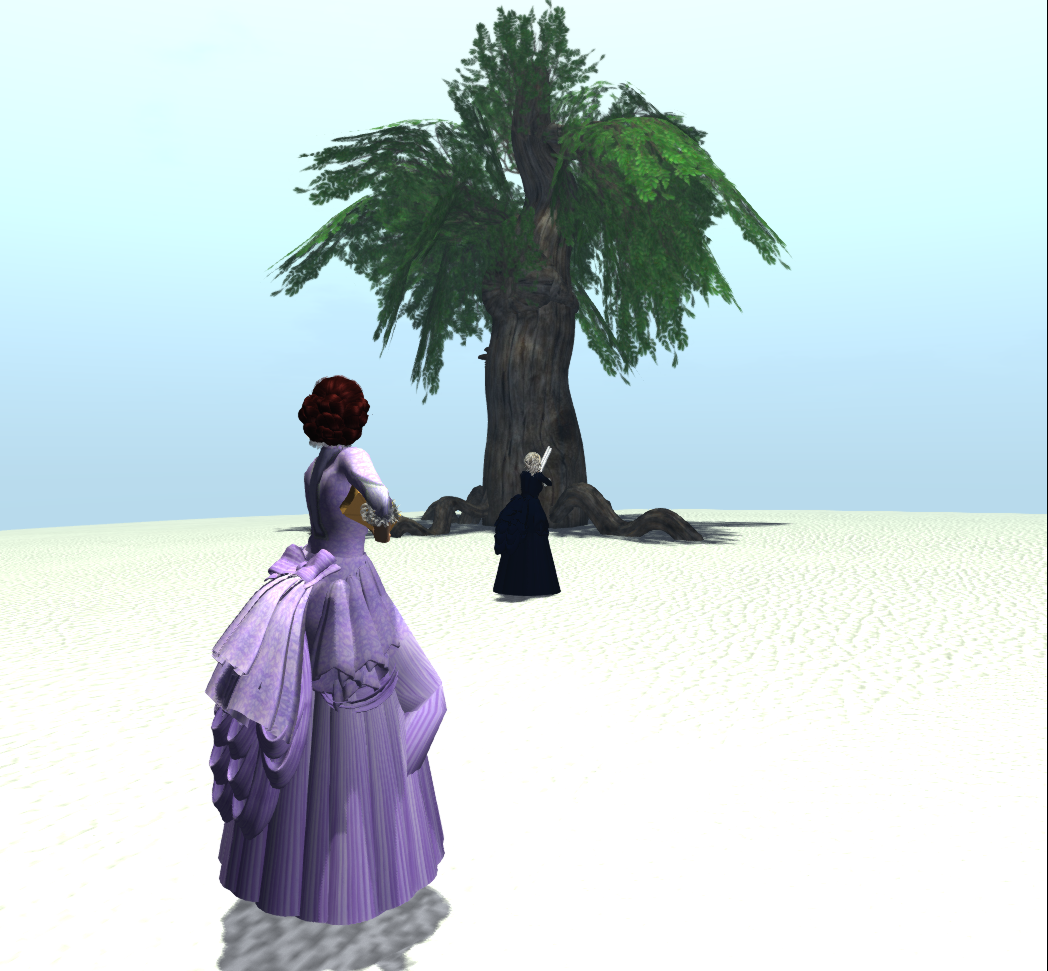
I need not have worried. There in the middle of a snowy lawn, stood a lady in late middle-age, reloading a shotgun, with a nearby tree as the apparent object of her target practice or whatever. I thought it best to introduce myself before she could raise the muzzles again.


“Mrs Beauregard?”  I called out. “Sparkle of Sound, with your ring and fob watch.”

The lady turned to scrutinise me as though she herself was suspicious of a trap. Then, breaking the barrels, she hefted her shotgun in the crook of her arm and marched over to me. Her face was lined through stress, but I saw in her an inherently jovial lady who had refused to let life trample her down.

“Ah, there you are, my dear. That’s wonderful. Do pardon the artillery, I was just scaring off the birds. Wretched magpie took my ring, you see.”

From what I’d seen, she was wearing her monocle over the wrong eye. The magpies were perfectly safe, which was more than I could say for anybody else within range of that shotgun which stared at the ground like two disconsolate drainpipes. Caledonians never did anything by halves.

“We call him Zeus,” Mrs Beauregard explained. “My late husband kept him handy when he was stationed in the far east, in his younger days. A double eight-bore is a powerful argument when the locals get restless.”


“But surely, Madam, if the magpies took your ring, it’d be in the nest?”

“That had occurred to me,”  said Mrs Beauregard sourly. “But as you can see, I no longer have the advantage of youth, so I’m not in a position to shin up a ladder. Easier to try and shoot the thing down.”

“I am,”  I offered. “If you have one available?”

Her eyes widened with joy. “I say – would you really do that for me? That’s most kind of you. Just wait here a moment.”

She stomped off back to the house and returned minus Zeus, and toting instead a ladder. “It’s my balance, you see. The first thing to go, if you’re not used to ladders.”

Bracing the ladder hard against the tree, I soon clambered up and located the nest. But that’s all that was there. An empty nest. I shook it about, turned it upside down, held it up to the light, but only a couple of beer bottle tops fell out.


I descended, empty-handed.  “I’m sorry, Madam; if a magpie took your ring, then it wasn’t this magpie.”

The news seemed to cut at her, making her bite off a bout of tears. “Blast. I’m sure they must have taken it. There’s no other explanation.”

“I’ve brought a replacement,” I offered, hopefully.

Mrs Beauregard gave a snort, her grief unmissable. “It’s not the same, though. I’d had that ring since we were married.”

“I’m sorry to hear that, Madam.”  A sympathetic lump rose in my own throat. “I do have your fobwatch as well.”

“Thank you, my dear. One moment.”  Mrs Beauregard produced a handkerchief from her sleeve, and blew her nose with a trumpeting that carried across the garden. “Would you bring it inside, please?”

Leaving the ladder where it was, I followed her inside to a parlour that was clean, but as dark and otherwise neglected as the exterior. At least it was warm, though. She took my parcel over to the window where she unwrapped it. I was relieved to see happiness break out on her face as she examined the fob watch.

“Oh, yes – he’s even set the right time. Thank you so much, my dear. I do rather depend on this for the time.”


I gave her a nod to reply, Indeed, Madam  but my attention was drawn to a large astronomical clock standing nearby. It appeared amazingly intricate, and I was sure that in a better light, it would be dazzling, although I couldn’t help finding it grotesque; it wasn’t the sort of thing I’d want on a mantelpiece. Marble was for civic buildings and tombstones, not clocks. Besides, it was also quite inert.


“You’ve discovered my secret, then,”  said Mrs Beauregard, sadly as though silently appending, And now you must die.

But I was only more puzzled. “Madam?”  I nudged.

Mrs Beauregard hesitated before crossing the room to a plain sort of framed certificate hanging up hard by the clock. “This,” she stated simply, unsure whether to cry again or to get angry with me.

“I’m sorry, Madam, I thought you meant the clock. I hadn’t noticed this.”

Suspecting that she might be about to divert me from this mystery, I stepped over to take in the certificate. I scanned the plain, official print in a couple of moments.

“DECLARATION OF SHERIFF AND OTHERS. 

“31 Vict. Cap. 24  [whatever that meant]

“We, the undersigned, hereby declare that  Judgment of Death was this day executed on Cuthbert Beauregard in Her Majesty’s Prison of Newgate in our presence. Dated this 1 day of March 1885.”

Underneath were sundry official signatures. Governor, chaplain – anyone who’d have been present at the event.


Mrs Beauregard took down a great double lungful of air and held it for a few moments, to steady herself. “They pinned that to the gate, the day he was taken from me. Now you know why I live so quietly here. I can’t bear to put that away, and it’s why I never let anybody in. I prefer to be alone with my memories.”

I felt as though I was intruding on something private. “I’m terribly sorry, Madam. I was assuming that you’d meant the clock.”

“Oh, that old thing! It hasn’t worked properly in years. I’ve never let it out of the house. Cuthbert loved astronomy; he’d had to learn the motion of the planets as part of his navigation. The Admiralty didn’t want its young officers confusing them with stars, after all. When I last saw him, two days before – the end, he told me that he’d be found innocent when Venus and Mars were in trine. I thought at first that he was being metaphorical – referring to war and love, somehow; I suppose he had to be cryptic with the warders looking on. It was only afterwards that I realised he was being quite literal. I’ve spent years sitting up half the night studying the sky, but on the one occasion the planets fell into that alignment, absolutely nothing happened. It was just another day, like all the rest since he was taken from me. Bleak.”

She was obviously riding a wild horse with her reminiscences, and I had decided it would be best just to let her ramble. But now she was getting upset and it was time to step in with the Londoners’ Panacea.. “Mrs Beauregard, would you like me to put the kettle on for you? It’s bitterly cold outside.”

“Thank you, my dear – that would be most kind. You’ll find the matches by the stove.”

The kitchen was like the rest of the house. Dark, neglected, yet clean. And thanks be to God, she’d had gas laid on. No faffing around trying to get coal to light in that mausoleum. Her gas jets needed cleaning, though. I used two matches before it became clear that I needed to give the gas more time to build up before applying a flame. So, I twiddled the knob, counted to five, struck a match and –

FWOOMF!


A cloud of town gas exploded in my face, making me step back. My heel jammed down hard into the floor, which gave way underfoot. The boards were rotten. I didn’t even have time to yell as I felt myself falling right through. Luckily, the joists were made of sterner stuff although they were as wormy as the floorboards. When I’d recovered sufficient breath to assess my situation, I found that I was jammed into the twelve-inch gap by my bustle.  Nothing was sticking into me, but I was well and truly stuck fast. Rapid cinematographic images flickered through my mind of Mrs Beauregard’s horror when she found I’d destroyed her floor, Mr Whybrow’s wrath at my carelessness (“Surely you’d have had the sense to be careful in a house so delapidated!”)…….

I was wondering how I was going to get out of there when Mrs Beauregard appeared standing over me.


“I’m sorry, Madam, it gave way under me.”

Mrs Beauregard was quite unabashed at the damage I’d caused. “My dear, I’m terribly sorry. This old place does need a lot of work on it, but I’m afraid I don’t even get a pension from the Admiralty, even though he was on active service.  Here, let me give you a hand – oooooops – “

The lady was no longer young, but her weight told in our favour as she pulled me out of the hole I’d created. After dusting myself down and inspecting my bustle for splinters, I looked into the hole. The joists were uninjured, and I wouldn’t have fallen far anyway. The ground was only about three feet below the floor.

“It’s fortunate you don’t have a cellar,”  I remarked.

“I do, but it doesn’t stretch this far back,”  said Mrs Beauregard. “Don’t worry about the floor, I can soon have that put right. I’m more concerned about your dress. Would you be so good as to turn your back to the light?”

“Don’t worry about that, Madam; it was my own fault.”  Nonetheless, I complied. My view of my own bustle was necessarily limited. As I turned, I chanced to look into the chasm. Something tiny glinted from its depths.

“Yee – ha!”

Poor Mrs Beauregard must have thought I’d gone insane as I dropped to lie on my front and felt around in the hole. But she wouldn’t have thought that for very long. I fumbled around with my fingers, and found what I was looking for. Small, shiny, round and with a rough edge. Triumphantly, I pulled out of the hole and held Mrs Beauregard’s ring to the light.


For a moment I thought that she was going to faint. Her face paled, and set like marble. Then her racing mind found its bearings.

“Ohmygod. You’ve found it!” Seizing the ring from me, Mrs Beauregard kissed it fervently, tears streaming down her cheeks. “I never thought I’d see it again – my dear, you can’t imagine how happy you’ve made me!”

It was left to me to help myself up. “Do you by any chance take it off when washing up?”  I asked.

“Well, yes – my fingers are thinner than they used to be, I worry about losing it down the plug hole.”

“Might I suggest that in future Madam puts it in an egg cup when washing up?”

“You can be sure that Madam will!”  Ecstatically, she clutched the ring to her chest. “And it looks like I owe the poor magpies an apology. No more letting off Zeus at them!”


I took the spare ring back with me. Mrs Beauregard had said nothing about payment, and with Mr Whybrow’s earlier advice in mind, I hadn’t mentioned it either. My delight at having found her original ring was only slightly abated by the darkness surrounding her late husband. He must have done something wrong to have attracted the ultimate penalty, yet she was devoted to his memory. Could he have been innocent? Or was she just too besotted to accept anything wrong with him?

I found Mr Whybrow waiting for me in the shop. He was pretending to tidy his office – I say pretending, as that was something he never did, so I could only assume it was a very clumsily-contrived excuse to wait for me and see for himself that I was all right. This, I pretended not to have noticed as I announced that Mrs Beauregard had not needed the spare ring.

“Indeed?” He raised an eyebrow, inviting me to continue.

I explained what she’d been doing when I got there, and why she was doing it. Mr Whybrow gave a mirthful grunt.

“I can see why she didn’t hit anything; she’s blind as a bat. Missed that rip in your skirt.”  He nodded to my rear side.

“Oh……….. I’m sorry, sir; I’ll stitch it up.”


“In your own time, there’s no rush.”  He bit off what he was going to add. Customers won’t be looking at your rear.  Because he’d have then added, Even if I do. And that would have embarrassed us both. I had the perfect means of breaking the awkward silence that followed.

“Sir – did you know that her husband had been executed?”

“She told you that?”

“She kept the official form they pin up on the prison gates when it’s been done. But it was at Newgate, and she said he was in the Navy, on active service. He must have been an officer; she said he had to know all about navigation.”

A gear or two seemed to have jammed in Mr Whybrow’s mind. “Beauregard, Beauregard………….”  I could see the jammed mechanism stumbling over, “Where have I heard that name before?”

Finally the tumblers dropped. “Oh, dear Lord, yes. I remember now. That’s going back before your time; almost before mine! It depends what you mean by ‘active service.’  He was a commander, but the Admiralty cashiered him and threw him to the civil courts when he was arrested for murder; they reckoned he was spying for Germany. There was a hell of a fuss in the papers. Witnesses not turning up, evidence not being produced – the case had more holes than Aunt Fanny’s drawers. The press reckoned the judge had been ordered to send him down by the government.”

Things began to make more sense. “She clearly still loves him, and I got the impression she accepts he was guilty.”

“Love can be the strongest pull of all,”  Mr Whybrow agreed. “It can drive many to do things they wouldn’t otherwise do, or stretch their faculties beyond the human norm.”

I could understand that; I’d seen it in the workhouse. My own father had put me there out of love, after all.

Mr Whybrow seemed to have misinterpreted my faraway look. At any rate, something must have been on his mind for some time.  “Yes, I expect that one day, someone will sweep you off your feet.”

Resolutely, I shook my head. “No, sir. I’m happy here.”

“Don’t underestimate the power of love. I lost a previous shopgirl to what was originally a casual customer. You’re as human as anyone else; one day a man will spirit you away on a cloud of rose petals, and I’ll give you my blessing.”  He turned to leave, darkly adding, “And on that day, the light will go out of this shop.”  He said it mezzo voce, as though not certain that he wanted me to overhear. But hear it I did.


 “Then you’ll have to learn to trust me, won’t you, sir?”

He spun on his heel, glaring back, but I met his countenance firmly. We remained like that for but a moment, but it seemed to last forever.

Finally, he admitted, “Yes. Perhaps we need to learn to trust each other.”

Then he was gone, leaving me with another enigma. What he had just said could be interpreted in many ways! But he was right. What he was trusting me with, was the ability to define the rules and change them at will. Only a man with a great deal of faith would do that. Or a man prepared to risk losing someone for the sake of seeing her happy ………..

Friday, 20 December 2013

A Ghost of a Chance

[Editor’s note: As has happened before, some of the pics which follow were taken at night, so they’re a bit dark. VB]

I half-fell down the steps to the cellar. Pausing only to shed my skirts, I set the crate carefully on its side with a single heave. The stout industrial lid stood no chance against my crowbar, and half a nerve-tingling minute later, there it was. A meticulously-engineered metal organism raising its twin horns at me, complete with all the nuts, bolts, copper piping, electrical leads and its own dinky little carburettor!


I knew that Mr Whybrow would be preoccupied with Mrs Beauregard’s work, to which he’d have given priority, so I saw no reason to delay mounting the engine. The instructions were as comprehensive as those for the new convenience, and in any case, there was only one place everything could go.

As I bolted it into its mountings, I could already see myself drifting down to land at Llyr, and dancing amongst the ancient stones, and Mr Whybrow’s wonderful surprise in the back yard gave me an added uplift while I worked; I felt a big, effusive happy angel watching over me. My own convenience – nay, a veritable powder-room! Even though I had yet to use it, I felt like a real lady of substance, although I had to see the funny side to it. Most gentlemen give ladies flowers, chocolates, jewellery – he had given me a toilet!

[Editor’s note – if you’re hoping for any pictures of the grand christening, you’re going to be disappointed. Sorry!  VB]

But engines are not simple things like gondolas and flushable conveniences. They have “settings” to consider, and ancilliaries to connect up. These came with the engine, but the evening was well-advanced before it was all in place, with every bolt torqued to its correct tightness. There was a lot to deal with, and unless everything was set just right, it wouldn’t work. I’d heard many of the terms used by Mr Whybrow without actually understanding them myself, but once I saw how everything related to everything else – top dead centre, valve clearance, spark timing etc, it all became quite logical.

All right, I’ll admit it. I couldn’t wait to interrupt my engineering to inaugurate my new convenience. I felt like a queen enthroned as I sat, and gave the chain its ceremonial first pull to unleash two gallons of water with a mighty eight foot head.

[Editor’s note: I relented. A moment like that just had to be captured on glass plate. But did you ever try taking pictures with a tripod camera, in the days before auto-timers, by pulling a string attached to the shutter?  VB]


When all the moving parts were correctly synchronised, bolting on manifolds and exhaust pipes was child’s play.

That just left the propeller. I had to saw a couple of feet from one of Mr Whybrow’s spares before it would clear the ground, but that was simple enough, and it was not long before the gondola was in all respects Ready.

I don’t know how long I spent standing admiring it. What I’d come to think of as a machine that just needed assembly was already an extension of myself, to transmute me into a flying creature, able to go anywhere at will in three dimensions, and with its own yet-to-be-discovered idiosyncracies that imparted it not only life, but personality. The engine had made all the difference; it now had a heart.


The next thing would be to test-run the engine for a few minutes, and then retighten any bolts that needed it. But it was late, and I knew better than to run an engine in the confined space of the cellar. Getting the gondola out wouldn’t be difficult; there was a goods ramp to ground level, and the Golden Grisset  would drag it out easily. A few more instruments would also be useful, and these I’d already set aside from one of Mr Whybrow’s boxes of spares.

Looking forward to the leisurely soak in the tub which I’d earned, instead of the usual hasty scrub-down, I dressed and headed for home, swinging the cellar keys with a playful tinkle as I left the shop. The first snow had already fallen during my incarceration in the cellar (yes, and in that other room) but the cold bite to the air only invigorated me. I was beaming with triumph, almost drunkenly, as my feet crunched through that soft blanket. I realised how remarkable it was that I’d been allowed to work on the airship undisturbed for so long. But then, it wasn’t remarkable at all. Mr Whybrow must have known all the time and privately, been wishing me luck.

Adding to my happy-floaty sensation was the crisp snow. I noticed that Mr Gongfermer had wasted no time in supplementing his income by shovelling the pavements clear. Unlike the unpredictable London weather, snow in Caledon always presaged Christmas and although few had put out decorations as yet, the advent of that day infused the atmosphere with a scintillating, electrical thrill like laughing gas without so many laughs.

My euphoria must have blunted my senses. I was almost home when I detected a soft, heavy footfall behind me, and a bag of some sort descended over me as far as my elbows, where it tightened, paralysing me as fast as a manacle. A hint of gorilla armpits reached me, telling me instantly what had happened.


I hacked with my heel, but Jasper was prepared for the move and I connected only with air. An arm tightened around my midriff, and I was hoisted off the ground. I was jolted about as he ran; his arm ramming into my diaphragm with every step to make me feel like a human bagpipe bellows, but not for long. My spine twisted violently, his grip left me, and I met the ground.

Coarse fabric stung my ears as the sack was snatched off my head. Raising myself to my elbows, I recognised my surroundings instantly by the moonlight falling through the windows. I was in the schoolhouse – an astute move on Jasper’s part; nobody would be coming near this part of the harbour so late in the evening.

I forced a painful breath deep into my bruised lungs. In that instant a shaft of moonlight fell across me as he stepped away, revealing another silhouette slouching on a desk like the school bully. I discerned only her shape, but that was sufficient to confirm her as Jasper’s companion, still in her guise of a maid. Her knees underlined her sneer with their bold indecency; I don’t know where she’d worked as a maid, but it wasn’t in Caledon. She spoke smoothly and level, yet overladen with menace.

“I think it’s time for a settling of accounts, don’t you? And this time there’ll be no avenging angel with a frying pan to save you.”


Jasper leaned over me, treating me to a cloudburst of tobacco breath. “Norra chance this time, my gel. Once ol’ Missus B gets into ‘er cups, she sleeps like the dead until the following sun-up. And in a few minutes, that’s just wot you’ll be doing. Only you’ll be sleepin’ like the dead ‘cos you are  dead!”  He sniggered, overcome with his own mighty wit.

I stood up; they made no attempt to prevent me. But then, with Jasper’s bulk blocking the doorway, my options were limited. Positively constrained, in fact, since he made a show of stropping a long knife against his palm, savouring the glint of the blade in the moonlight.

“Thank God for corsets,”  I told him. “It’s only thanks to mine that my sides haven’t split with laughter.”  My freedom was beyond reach at that present moment, but I could still regain my dignity. With a deep breath to steady myself, I observed, “You’re remarkably ready to hazard your own lives. You can’t kill me without putting ropes around your own necks; everyone here knows about you two. You were that widow who tampered with my bike’s brakes, weren’t you?”

Jasper’s companion stepped forwards, her heels clacking on the tiles. She gave out a chesty chuckle. “I have many guises. And as for our own prospects, I think not.”  She caressed my cheek with the backs of her fingers; suppressing a shudder, I suspected that under other circumstances, she could have taken a different sort of interest in me. “No-one will be finding you in anyone’s lifetime, Miss Bluebird. When you’re put to sleep, it won’t be in your own bed. It’ll be on the sea bed, with half a hundredweight of stone to keep you there.”


Even as she spoke, a noose flicked about my waist and grabbed tight, pinioning my arms. I damned my latest carelessness at having allowed her to distract me while Jasper threw the rope. He yanked yard, almost cutting me in two, holding me fast while his lady wrapped a couple more turns about me and tied a knot. I tried another kick, but she sidestepped easily. Blast!

There had to be a way out of this, but no skill would avail me, held immobile as I was. My mind raced, but Jasper wrenched my attention back to him with a leer which, in the poor light, made him resemble a disinterred corpse. “You and Mister Jeweller should have left alone fings wot don’t concern you. And now it’s personal, too. You cost me my job and took my mate ‘arry.”

What?

“Be glad that’s all I cost you,”  I retorted, livid at his compounding evil with untruth. “And I didn’t take Harry; you poisoned him.”

That got him. Jasper took half a pace back. “You wot?”

“You poisoned my milk, didn’t you? Well, he drank it himself to warn me.”

Jasper astonished me by clutching at his eyes and doubling up in grief. But then, despite his appearance, Harry did have certain endearing qualities. “Oh, my Gawd! Wot’ve I done?”


“Shut up, you fool,”  snarled the woman. “You want to wake up the whole neighbourhood?”

“I’ve killed ‘arry!”  Jasper wailed.

Maybe I should have let him go on thinking that. It might have put a rift between them. But fool that I was, I had to give him the truth, even if it was to let him know that he couldn’t even murder a spider without making a hash of it. “He’s alive and recovering,”  I told him. “I found him in time and managed to save him.”

“He’s gonna be awright?”

“Yes, and for that, you can thank Mister Jeweller. If he hadn’t had the remedy to hand, Harry would be buried in the park. But I’d write him off as lost, if I were you. He’s tired of your uncouth criminal ways. He’s switched sides, Jasper. He doesn’t want to see you any more.”

I let him soak it up as I stirred a dagger in the one thing that meant anything to him. It’s amazing the sort of bond that can arise between the most unlikely partners, but I was going to play on it.

His lady knew that,too. She punched him on the arm. “Put your personal feelings aside, damn you! She’s learned too much, so there’s an end of it - and her. But don’t worry, my dear.”  She caressed my cheek again; a thin smile split her face in two. “You’ll soon be reunited with your darling jeweller. Once you’re out of the way, we’re going to do the same to him. I’m sure you’re quite used to him going on top, eh?”  She gave me a jocular punch on the arm; Jasper snerked like a moron but I could only fume. Those two would never accept the truth, anyway.

She then forestalled any further attempts I might make to protract the proceedings, by flipping out a handkerchief and tying it tightly around my mouth. Starched linen, by the feel of it, which was no small mercy. I think I’d have passed out if she’d used one of Jasper’s hankies. His arms wound around me, almost making me retch as he held me still for his lady to tie another rope about my ankles. I tried kicking out at her, but Jasper gave a wrench to my diaphragm that bought her all the time she needed to lash me to a chunk of masonry which I recognised as having come from our own back yard.

Bundled up in my skirts, Jasper slung me over his shoulder like a palliasse. I wriggled, I twisted, I tried to kick out, but I could only seethe helplessly as he lugged me out to the quayside with his companion toting the ballast. Mr McKew was long in bed, and the police station was unmanned at that time of night. I tried to scream, but that woman had been too good with her gag, and I only made my throat sore.


At the quayside edge, Jasper stopped and started to unsling me.

“Not right here.” His woman’s snarl carried easily on the light but biting winter breeze. “It’s nothing like deep enough. Cross over the ships and put her in where it’s deeper.”

My breathing apparatus, already bruised, was knocked about by Jasper’s shoulder as the gangplank sprung and flexed beneath his step. I tried struggling again, but was held quite fast. Gawd, isn’t there anything I can do?

Then everything happened at once.

A green glare appeared – I imagined that some sort of cavorite bomb had exploded nearby. Jasper emitted a dreadful gargle of pain or panic, while his lady let rip with a scream that made my High C sound like a lullaby. I could not see what had terrified my captors, with my view limited to Jasper’s rump and his alternate feet as he walked, but I wasn’t given time to consider it. The uncomfortable obstruction left my diaphragm, I was in mid-air. But only for an instant; in the next, the gelid waters of the harbour closed over my head.


Christ I’m going to drown!


I’d swear that the coldness of the water stopped my heart as it cut at me like a huge razor blade, adding malicious impetus to the constriction that was already driving my remaining breath from my chest. It was desperate reflex rather than commonsense that led me to thrust my feet downwards into firm-ish mud. I lanced my body upwards, in the hope that maybe my nose would reach the surface, and found two feet of wintry air cutting at my sodden dress. The rest of me was in three feet of steely-cold water with my feet mired in several inches of thick sticky mud.

I blinked water from my eyes to find my captors fleeing for their lives. The green glow still hovered over the quayside, limning a figure I would never have expected to see. Had it not been for the ethereal radiance, I’d have believed that Spring Heeled Jack himself had come to my rescue, but my saviour wore no skin-tight mask, and the leather-suited figure of legend always spewed blue or white flame, not green. However, I was no less glad to see him. It was Uncle Arthur, the very epitome of demonic wrath.


He stood, presiding over the quayside, until my captors were lost to sight and hearing. I suppose he could have gone after them, but he couldn’t have frightened them any more than he already had.

I was completely unafraid of him as he remained for a moment, staring into the distance to reassure himself that their absence was guaranteed, and then turned to me and cut a bow. I was never so glad to see someone, although I’d hardly expected my saviour to be a ghost. A waft of breeze cut through my sodden dress, sparking an electric shiver. “Sir, can you help me – “

He held up a patient hand. Wait.


Then he was gone and with his departure, went all life from the harbour.

Grateful as I was regarding my rescue, and stunned with disbelief, I began to fret again. I couldn’t move the gag, the quayside was too high up to reach, and my already-numbing fingers were held beyond use by the bonds that were gripping tighter. I don’t know why those two had worried about being overheard; not a soul was in earshot. So there was nobody to get me out of the water before I succumbed to hypothermia. Above me, the snow clouds cast their frosty petals dispassionately over SouthEnd and over me; I couldn’t even blow away the cold tickly flakes that landed on my nose. I began to wonder if it was true that freezing to death was like falling asleep, but then most of those people weren’t standing upright in water – would I actually drown?


Then a fresh footfall clattered from the street. Urgent, and wonderfully familiar. Even in the sparse light, I recognised Mr Whybrow’s silhouette as he ran around the corner, paused to dart searching glances about the harbour, and bolted over to the quayside. I noticed a revolver in his hand; somehow he had learned about my predicament, as he had arrived expecting trouble. So that was why Uncle Arthur vanished so quickly; it was he who had summoned Mr Whybrow.


He wrestled the gag from my mouth and at my gasp,an icy girder transfixed my lungs. I tried to speak, but the words lacked the strength to emerge from my shuddering chest. Mr Whybrow thrust his revolver back inside his coat, and leapt into the water beside me. “Don’t move; I’ll soon have you out of here.”

He dropped below the surface and my deadened ankles felt some furtive activity about them; I remembered that he always carried a penknife. There was a brief tugging, and the rope fell away about my feet. Then strong, agile fingers probed about my waist – another tugging, and my arms were freed.

“Come on. Can you climb out?”

I tried to answer, but again, could not speak – I wasn’t even sure what I was trying to say. My whole body felt as though it belonged to someone else, it would no longer obey me at all.

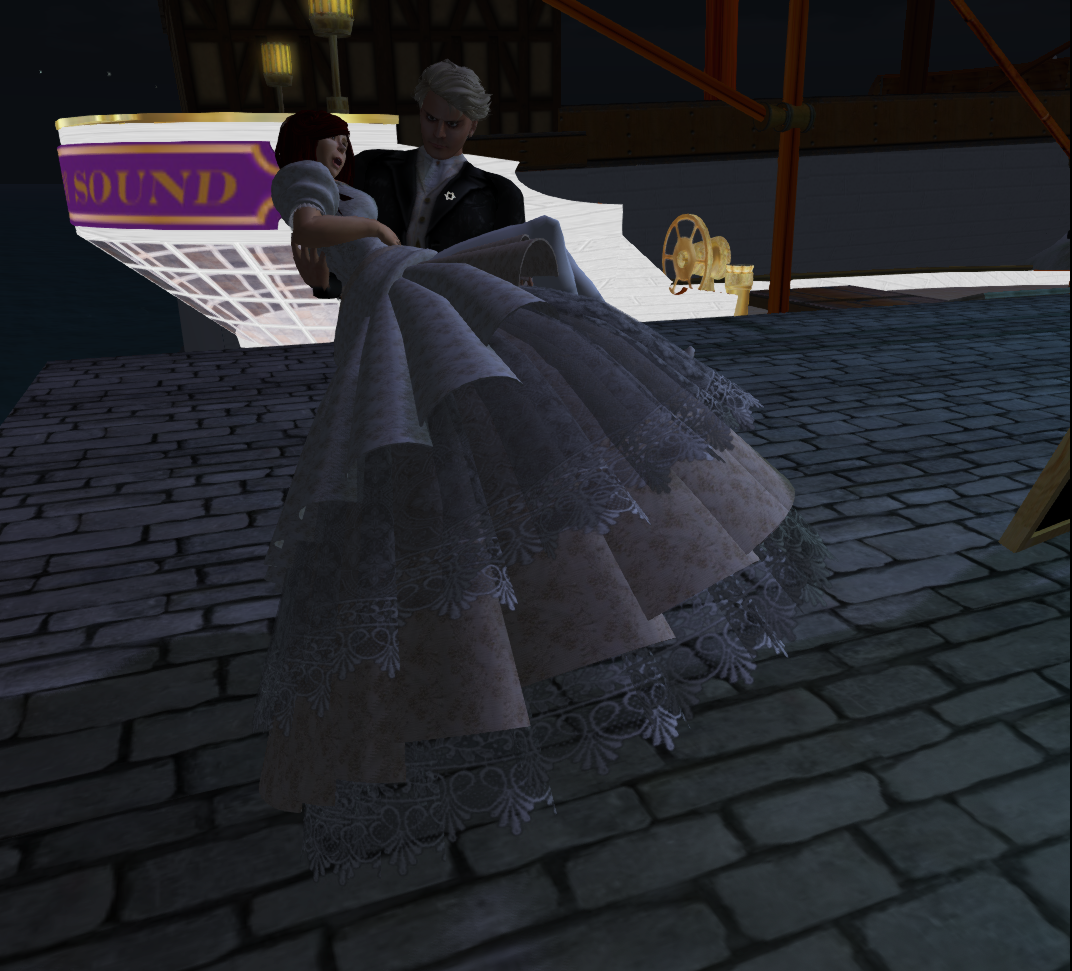
Mr Whybrow muttered, “Of course she can’t, you daft ha’p’orth.”  Then he scooped me up in his arms and carried me up the slipway, to the street. “I don’t know,” he chode, mirthfully. “Two dousings in a day, and the second one, you dragged me in with you. Thanks so much.”

I knew that he was not really angry; just trying to cheer me up, but I could not reply. The water, which had been a single frigid corset on my body, sucked up the gentle wintry breeze to penetrate to my very bones. Although he was as wet as I was, I snuggled my head into his waistcoat as he carried me through the snow to my house. The silly idea ran through my head that at that moment, I could have said absolutely anything I pleased, and even if he understood it, he’d just ascribe it to the feeble ravings of a half-expiring mind. As it was, I contented myself with calling down a thousand feverish blessings on the confident arms that were bearing me home, and the great heart warming my ear inside his sodden waistcoat.


He set me down at my front door; my quaking hand fumbled the door key from my blouse and passed it to him.  He ushered me inside and made straight for my candle, which he lit with a hand which was nearly as unsteady as my own. “I think I can guess what happened. Some of it, anyway. Can you speak yet?” He was plainly fighting to keep his own voice steady against the frigid hands squeezing his lungs.

“Jasper and that woman,” I mumbled. Gawd, I sounded almost comatosely drunk!

Mr Whybrow took my candle to the fireplace and gave me a stern look up and down. “Get those things off – all of them. Just chuck ‘em into a corner for now. Then dry yourself thoroughly while I get this fire going.”  He managed to look authoritative, even while dripping puddles all over my parqueting.

“What about you, sir? You’re as wet as I am.”

He shook his head.  “You were in the water for longer. Don’t worry about me.”

Without the wind to play on the chilly wetness, my strength and control were already returning, but he was right. I stumbled into the kitchen and rubbed my hair briskly with a towel while he rustled old newspaper and clinked coal on top of it.


“Someone fired an empty tube up the Lamson,”  he called out. “I thought you were in trouble, but finding you as I did, I’m a little curious as to who fired that thing.”

Wrestling free of my blouse, I drew a deep breath for strength, and gushed, “They were waiting for me outside the shop – took me before I was ready. They were going to drop me off Old Stumpy, but Uncle Arthur turned up and scared them away.”

Even from the next room, with a wall between us, I could see the respectful roll of his eyes. “Well, well. Someone’s watching over you, then.”

It certainly looked like there was more to being dead than startling the occasional shopgirl in her own home. Then I remembered the rest of it. I leaned out and told him, “Yes, but sir – they know we’ve discovered their racket. They were going to drop you in the water after me, and they’re after Mrs Boltclyster, too.”


“Christ.”  He steadied himself. “Have you got your revolver?”

“It’s in the shop, sir.”

“A fat lot of bloody use it is there. All right – I’d better check on Mrs Boltclyster. Lock the door after me and don’t answer it until I’m back.”

With that, he bolted out, although I think we both knew that those two had been too badly rattled to bother with Mrs Boltclyster for a few days. At least he was considerate enough to shut the door behind him.

My fire was a merry blaze of newspaper; the coal was just starting to catch. I gave it a few puffs of bellows for encouragement, and returned my attention to myself. I peeled off my horribly clammy underthings and stockings; it was like shedding a layer of malaria. The growing flames played over me as I briskly towelled myself down, and wormed into my nighty.


My clothes having been in the harbour, I squished the lot into a bucket and filled it from the kitchen pump, adding a tablespoon of Jeyes’ fluid to be on the safe side, and then collapsed gratefully into my chair to watch the flames grow. I remembered from my workhouse days that if someone had frozen near to death for any reason, one of the best ways of restoring their body heat was “shared warmth”  which in our case, meant somebody particularly close climbing into bed with them when the lights were out – in living memory, it had been common to use the servants as bedwarmers, so nobody condemned the practice. But that option was not available to me for two reasons. One was that it only worked if you were unclothed, otherwise your clothes would insulate your warmth from each other. What was more to the point, were I to suggest such a thing to Mr Whybrow, I would get warmth a-plenty from his volcanic eruption.

I began to take stock of my situation, wondering if Jasper had really been frightened off for good, but a brisk knock came at the door.

“Miss Bluebird? It’s only me.”

I admitted Mr Whybrow; he ambled over to the fire and warmed his hands. He had dried himself and changed; there was nothing to show that he had been in the harbour. “Mrs Boltclyster’s all right, and she keeps pretty good precautions of her own. Bucket of horse manure over the door. If I hadn’t known how her mind works and checked, I’d have got it all over me. Here – “  He delved into his pocket and produced a bottle of brandy.  “The best medicine known to man. Park yer bum a moment, will you?”

He disappeared into the kitchen and returned a moment later with two glasses with an inch and a half of amber promise in each. “No soda, no water, just the pure stuff. But sip, don’t gulp.”

Some control restored, I lowered myself into the chair and did as he suggested. The liquid soaked into my bloodstream quickly, coursing through my system like a gentle liquid fire.

“So Mrs Boltclyster’s well?”  I nudged.

“As well as someone’s likely to be when they’re aroused at this hour and have the disposition of a hung-over lioness,”  Mr Whybrow grunted into his glass. I guessed that he had not been received with any gratitude, even though he might have saved her life. “I’m tempted to put the authorities onto those two, but they’ll have vanished by now. That’ll only make it more difficult to get any response from officialdom when it is  in a position to do some good.  So they know that their cache has been discovered?”

“Yes, sir. We hadn’t disturbed anything, they must have left something to warn them that someone had been there.”

“Probably a thread crossing the threshold. The oldest trick in the book.”


Cupping my glass to warm the brandy, I leaned forwards urgently. “Sir, who is  that woman?”

“Her name?”  Mr Whybrow gave me a curious squint, as though I’d confronted him with an intractable crossword clue. “I know of several. She changes names like underwear. Tell you what is puzzling me, though.”  He swirled his brandy about the glass and studied the clavichord, as though the answer to his quandary was written on the lid. “I’m impressed that Uncle Arthur could fire the Lamson. All right, we know little about spirits, but – well, he is one, isn’t he? I wonder how he managed it?”

That point should have occurred to me. “I don’t know, sir. Maybe desperation gives them the strength they need?”

“Like a seven-stone mother can lift a half-ton cart off her infant? I have to admit the possibility, but – “  He turned it over again, unconvinced. Then he looked at me sharply, but with kindness in his eyes. “Miss Bluebird, you are quite obviously in immediate peril of your life. Are you quite sure you won’t accept my offer to retire to a different part of the world, at least until the danger is past?”

His words, and the sincerity behind his eyes, gave me the strength which the brandy had yet to impart. I stood and took his hand in mine, fixing his stare sternly with my own. “I’m in no more danger than you are, sir. I won’t be driven away from y – “  I caught myself and hastily resumed. “ - everything you’ve given me; nor will I leave you to face them alone. Unless you fire me, we’re going to see this through together.”

I think he’d picked up on my hesitation, although I suspect he’d have behaved no differently had he not. To my surprise, he responded by doing something that he’d never done before.

He clamped his arms around me and pulled me to his chest. My automatic reaction was to pull back, but I stifled it instantly, lest he react to my reflexive panic and drop his hold.  To make sure that my true wish had been understood correctly, I nuzzled into his cravat. He, too, tensed a little, but relaxed. I guessed that he’d been prepared for either reaction from me, but had been hoping for the positive one.


Softly, as though he had not meant me to hear him, he murmured, “Good. If any harm came to you, I wouldn’t rest until I’d killed him. And if he succeeded in driving you out, I’d shoot him anyway, however I find him at the time.”

I don’t think he noticed my slight tensing as I caught my breath. The law would look leniently on someone who shot a danger to life, but only when that danger was immediate. I’d seen the depth of his care exhibited in numerous little ways, but I knew from his dreadful stillness as he spoke, that it went right to the very core of his being. He would carry out his promise as surely as night follows day, and I had never thought that any man would risk a visit to Mr Billington over me. But then, a man who single-handedly builds his shopgirl her own convenience tends to keep his promises.

[Editor’s note: James Billington served as executioner in the United Kingdom from 1884 until his death in 1901. I hope the reader will understand the difficulty in recreating Mr Billington, when the only remotely reliable pictorial record of that individual is a drawing of middling quality. The execution chamber, however, IS a fairly faithful reproduction of a standardised British facility which was in use in the 1890s. Forget the multiple-coiled knot; the UK had long abandoned those by this time. VB.]


I took advantage of Mr Whybrow’s cravat to hide the awe which, unbidden, froze my face. He must have read it from my stillness, as he changed the subject.

“How’s your patient, by the way?”

I flew back, almost stepping into the fireplace. “Oh, my God! I’ve been sitting – “

I looked back to the chair, but there was no appalling travesty to haunt me for the rest of my life; just a few crumbs of charcoal biscuit, for which I thanked God. It had taken that mortifying shock to show me just how much I cared for something that I was too scared to pick up.


Mr Whybrow spoke for me. “Good Lord; he’s gone.”

“So I see.”  I hoped that I didn’t sound as horrified as I felt. It could have happened so easily.

“Jasper couldn’t have got him, your door was still locked. You did say he was recovering; he’s probably scuttled off somewhere.”

“Of course, that must be it,”  I sighed. I knew then how the Lamson tube had come to be fired. And it wasn’t by Uncle Arthur.

Mr Whybrow made a point of checking his watch. “Well, life has to go on. If you want a lie-in, I shan’t object, but I reserve the right to call for you if I get too worried.” He sounded slightly awkward, as though looking for an excuse to be elsewhere. Twitching a sheepish smile, he added, “If you have any trouble getting to sleep, think about your airship. Oh, and don’t leave this behind again.”

Fishing my revolver from his belt, he handed it over and was gone.

He was right. Jasper wouldn’t try for me in my bed again after what had happened the last time, and there was no point in dwelling on my latest escape, narrow though it was. I did, however, notice that Mr Whybrow had not repeated his previous offer of sanctuary in his own home. I suppose I had been somewhat careless with his pride, in the way I’d handled that.

The room suddenly felt dead, as though something was missing. Well, it was. I’d got used to my little eight-legged patient, although cold commonsense told me to be more realistic. I addressed the empty room. “Sorry, Harry; you’re as much a victim as the rest of us, but don’t think of settling down here. You and I just wouldn’t make good bedfellows.”

To be sure, I tore the sheets from my bed and searched thoroughly before settling down to what remained of the night.