Wednesday, 20 November 2013

INTERMEZZO

Or

Brief but necessary editorial digression.


Before I go any further, I need to weary the reader with a few facts.

I have been accused of tactlessness in making light of the Victorian workhouse. Let’s get one or two things straight.

First of all, forget “Oliver.”

At the time this narrative is set, some 60 years after the time of that musical, workhouses had improved a lot. Historical tales of squalor as portrayed by Dickens were quite realistic and were still well-known in the 1890’s, and the authorities were determined that such should never happen again. Some of the bigger metropolitan workhouses had relocated to purpose-built complexes in the country, and included central heating and proper sanitation along with the healthier country air amongst their amenities. I shan’t tax the reader’s patience with details of diet and infirmaries (which could be almost as large as the workhouse itself), as the critic can find these readily on the net. Suffice it to say that any shortcomings were due to the general lack of sophistication of the times, for which our forebears cannot be blamed, along with limited resources, rather than any deliberate neglect on the part of the workhouse itself. As is inevitable with large institutions, reports of abuse did occasionally come to light (and still do, long after the abolition of the workhouse), human nature being what it’s always been, but these were dealt with – either by the administration itself, or in the case of criminal activity, by the courts. Investigative journalism was active even then, and the administrators had their reputations to consider. And when one reads the tales emerging from orphanages and old folks’ homes in more recent times, are we really any better now?

Whilst the workhouse was never intended to be luxurious, and admission was seen by most as a last resort, it beat the alternatives by a long chalk. The authorities concerned were equally anxious that while the workhouse should provide basic conditions for the needy, they should not be seen as an easy option for the idle, who existed then as they do now. Resources were too scarce to be spent on those capable of supporting themselves.

Yes, workhouse life was strictly regimented. With residents in the larger establishments numbering in the hundreds, some discipline was necessary, and was enforced. Yes, the genders were segregated, which meant breaking up families.In the days before contraception was easily available, what else could the authorities do, when the last thing they needed was to encourage more infantile mouths to feed and care for? Not to mention the spread of certain diseases which many prefer not to talk about, but which, in some parts of London, had infected up to 1/3 of the population, and were terminal unless something else happened to kill you first.

I can understand how one might be tempted to think of workhouses as prisons, or Trappist monasteries minus the vows. This is utterly incorrect. Yes, it’s true that prison inmates knew they had a definite release date, and a monk could walk out any time he wanted. So it was with workhouse residents. They could leave at any time. It would be a mistake, however, to forget that workhouse residents were kept “inside” by the very conditions that put them there in the first place. The modern social security system did not exist in the 19th century; consequently, it would be a big mistake to imagine that one could fling the gates open and announce, “You are all free.”  Where would everyone have gone? What would they have done?

By way of a minor digression – yes, many young men discovered a way out of the workhouse when the Army began recruiting en masse in 1914. Those who have already looked into this will have been surprised to learn that a sizeable proportion of candidates were rejected as medically unfit. One should, however, not overlook that the Army’s recruiting machine were equally surprised at the number of unsuitable candidates they discovered outside the workhouse, both in cities and in rural parts. The Army’s standards weren’t as exacting as they were in the 1970’s of the typist’s own experience, but nonetheless, they did have standards for which the workhouse cannot be blamed – any unfit candidates were almost certainly unfit before they arrived at the workhouse.

As for the activities conducted in the workhouse - yes, rocks were broken and yes, oakum was picked. But there was also the chance to learn a trade such as bootmaking and tailoring. And let us not forget that since a workhouse was a self-contained community, any workhouse worth its salt would use any specialist skills which might be possessed by residents, and where possible, would train replacements. As for the more “human”  side of life, I refuse to believe that humour did not exist in the workhouse. There is ample evidence to show that concerts and divers entertainments were arranged both by the residents and by visiting artists. With this in mind, allowing humour into the context of the workhouse is no more distasteful than including it in the contexts of pirates or the Royal Navy of the Napoleonic era (both of which are popular subjects for humour, while being widely misunderstood), and infinitely less so than the revisionist history routinely publicised by Hollywood, and which many who don’t know better are happy to accept as gospel.

On a more personal note, relatives of mine lived and died in the workhouse. I know where these were, what they were like and how they were run, be that for better or worse. Consequently, I have the right to state categorically that I know what I’m talking about. Critics are advised to do their own homework before launching allegations. I will not censor, slant or otherwise rewrite my narrative to suit the misconceptions of others.

Now, back to what I was doing………

VB

Monday, 11 November 2013

Interred

It was only with a tiny twinge of trepidation that I approached the Dreadnought. It was hardly the bike’s fault that the wheel had come off, after all; it had otherwise been a friend to me. And this time, I didn’t have to shed my skirts first! It was a luxury, to be able to stretch out in the sidecar and let someone else do the driving.

Without turning my head to him, I was looking at this particular someone in a new light. He’d kept his promise. He knew I could look after myself, but when I was out of my depth, he stepped in and slayed the dragon for me. That made me all the more determined not to let Jasper and Miss Pirate Maid drive me out.


The air enlivened me as it caressed my face. Caledon on Sea wasn’t far away, and Mr Whybrow knew the district well. He headed unhesitatingly for the right house, and left me in the sidecar while he dropped off the lady’s purchase, with the engine ticking over as a deterrent in case she took it into her head to invite him in. He was always suspicious of such invitations, and had good reason to be.

While I waited, I watched the train coming in. It bore a single passenger, a tall female figure. She was a mere silhouette in the distance, with her face disguised under a veil, but when she stood to de-train, a moment’s comparison with her background informed me that the apparent colourlessness of her garb was not due to the distance; she was wearing a widow’s weeds. She stepped behind the train, and when it pulled out a few moments later, she was lost to sight.


The warmth of the engine and its fug of hot oil was a strong but subtle soporific. I was starting to drift off to sleep when Mr Whybrow’s footfall aroused me sharply.

“Problem solved,”  he told me as he swung back into the saddle. “Said she’d thought of buying the spider ear pendants, but they scared her too much. It’s a funny thing, but when I first built them, most of the women were ecstatic. ‘Ooh, I love spiders.’  Now everyone’s afraid of them.”

“I wonder if Harry’s been getting about?”  I suggested.

Mr Whybrow put the bike into gear with an impatient jerk and grinned. “Harry’s going to be one friend less, now. You  might just be seeing more of him.”

I thought back to Harry’s well-timed appearances on my hand mirror and in the till drawer. “You could well be right, sir,”  I told him with a shudder.

He pulled up by the pier entrance and helped me out of the sidecar. For the first time, I noticed a little sign by one of the main supports, and I blinked repeatedly to make sure I wasn’t imagining what I was seeing. “Caledon NUDIST Beach?”  No, just to make sure its meaning was understood, underneath that forbidding legend was, “No Cothing beyond this point.”

“There are those who enjoy the air au naturel,”  Mr Whybrow explained. “There aren’t any other public facilities here that I know of, although what people do on their own land is their own business.”


All right, so Caledon was full of surprises, and it shouldn’t have surprised me that some liked to bathe in a state of nature. But the skimpy bathing costume took enough getting used to; the idea of Caledonians cavorting about in only skin and hair did not bear thinking about.

[Editor’s note:  So no nudie pic here. Sorry!  VB]

But one thing seemed to be missing. The beach.  “I presume that nudists can only use this when the tide is out, sir,”  I nudged.

Mr Whybrow gave a low chuckle, having followed my gaze.  “We have no tides here, Miss.”

“Then what are they supposed to use? Nine inches of lawn?”

“Would it help if I told you that the sign was placed there by Mr Hax? The same gentleman who gave us the death roller and the exploding turkey?”

“Ah.”  All became clear. “Of course, one would expect such a gentleman to have a keen sense of irony.”

“Precisely. Anyway, I wouldn’t expose you to a place like that even if it was genuine. Now, shall we take the water? I’ve a lot of dust to wash out.”

We changed as before; this time I did not feel so self-conscious, even though I could not escape the suspicion that we were being watched. In particular, by a tall woman in widows’ weeds.


He did not wait for me, but plunged straight into the sea, leaving me to catch up while he let the salty water wash all the dust from him. I was more confident when I stepped in; it was no longer terrifyingly unpredictable and I knew how to handle myself – standing up or floating, at least. More importantly, my misadventure while collecting Cavorite had hammered home the importance of learning to move in the water. As Mr Whybrow knew.

Just to show keen, I took a deep breath and lay back a few feet from him, to let him see that I hadn’t forgotten what he’d already taught me. He did not waste words of praise, but merely remarked that I seemed more comfortable this time.

“I think you’re ready for the next lesson,”  he told me. “How to swim. You’ll float just as easily on your front, just keep your head well back and your chest full of air.”

I did as he said. It was not so easy, actually; my legs wanted to sink. I wallowed like a barge going under, my feet scrabbling to find the bottom. When I could stand, I spat out seawater while he laughed.

“Not just  yet, I hadn’t finished!” He then explained how to kick my legs, and gave me a demonstration of how to use my arms as oars. “You can swim as easily even from treading water, it’s a matter of how you launch yourself. But let’s take it one step at a time. Just fill your lungs and lie down.”

To my surprise, he extended his arms just below the waterline and when I surrendered myself to my natural buoyancy, such as it was, I found two firm supports at waist and breastbone level.


He gave little hints of encouragement and correction until my limbs were moving in some sort of synchronised harmony. At which point, I noticed that – no, there could be no mistake about it. I was moving! But how did Mr Whybrow manage to keep his support in place?

Obviously, he had not. Turning proved surprisingly easy, and I found it impossible to be angry with him as I saw him following my progress with approval as he neared, under my own power.

“You took your arms away,”  I accused.


“I did that as soon as you were stable in the water,”  he laughed. “Didn’t you notice?”

So most of the time I was floating, flapping arms and legs about, I was entirely unsupported. I wanted to erupt with fury at him, but some little demon inside me was yelling, “It’s funny! Laugh!”  All I could manage was to screw my face up and blurt, “Sir, you’re a – a – monster!”

Naturally, his immediate reaction was to laugh all the louder. Utterly lost for words, I could only splash him in frustration, which he returned with a splash of his own, like a wash like one of those new-fangled destroyers passing at full pelt. Being me, I screamed, panicked, and fell over, going right under. I shot to my feet, and spat out more salty water.


“You – you – utter – “  That last word would not come. If it had, he wouldn’t have taken it very kindly.

But that was precisely what he was doing. He stood there inflexibly; it was like trying to level a friendly mountain by throwing buns at it.  Something softer, more caring, entered his eyes. “Do you feel better now?”

For a moment, I could only stare, humbled. He knew exactly how to handle me. What could I do but smile back?  “Yes – thank you, sir.”

Softly, he advised me, “Endurance will come with practice. To be on the safe side, stay within your own depth until you can swim from the pier to the rock opposite and back. When you can do that, you’ll be strong enough to get yourself out of any difficulties – provided you keep your head. That’s the most important part.”

I was about to reply, but I was distracted by a dark shape moving about near the Dreadnought. My eyes were still swimming from their dousing, by the time I had blinked away the water, all was normal and the shape, dismissed as possibly a trick of my imagination.


“Is something wrong, Miss Bluebird?”

“No – no, thank you, sir.”  But I did not sound as certain as I might have been.

I kept swimming, within the area he had defined, for the pure joy of it. I’d learned something new, and was determined to be good at it. Mr Whybrow was content to float, left to his own thoughts. I could guess what they centred around, and when my legs started to feel heavy, I joined him as another human raft floating on the sea, mulling over the world and its problems – calmly and analytically, without fear. Although there was one thing that had to be said.

With subtle undulations of my ankles, I edged closer to him. “Sir? I’m sorry to have brought this trouble upon you.”

Mr Whybrow replied with a careless drawl; he might have been drawing attention to an interesting cloud formation. “You didn’t bring anything upon me. For a start, he’d have tried it on with any other shopgirl, and probably with worse results. And even without our postman, I’d have still been the target of that woman. I don’t think she’s going to let well alone.” He reached across and gave my hand a squeeze. “But since she’s there, out for blood, I can’t imagine anyone I’d sooner face the situation with. You’re a girl in a million, Valerie.”


Again, he’d called me by my first name. I could only mouth my thanks back to him. I did not dare suppose that there was anything romantic behind the warmth of the look he gave me, but there was no doubting its sincerity. I returned the squeeze with my own spindly fingers, and let it linger. I’d been feeling a bond building between us as something almost tangible, like that cord which spiritualists talk about. Now I felt it between us as a living thing. He’d accepted me as part of himself, and I was a little surprised to realise that I’d accepted him likewise – probably for some time, without being aware of it.

“They both have reason to hate the pair of us, sir,”  I ruminated. “Do you think they’ll be working together?”

“I think so,” he decided, without hesitation. “Although he’s too clumsy to plan ahead. I suspect – no, I’m pretty certain that anything Postie does, will be under her direction.”

“Don’t you have any police here?” I demanded, yet without acrimony.

“Yes, we do. But so far, nothing’s happened that they can act on. I’m afraid we’re on our own unless they get careless.”

I bit my lip. This was starting to sound like many stories I’d heard in the workhouse. Good people, otherwise just wanting to go about their business, harassed by others with the police either apathetic, or powerless to act.

“You don’t think they’ll give up?”  I asked.

“I know they won’t. Postie might, left to his own devices, but I know her type only too well. Don’t you worry.”  He squeezed my fingers again and this time, added the wink of an avuncular magician. “We’ll see them off. Our skin’s starting to get wrinkly,” he observed. “Shall we head back?”

He left a hint of uncertainty hanging over his invitation, offering me the chance to put off our return until I felt ready, but I didn’t think I’d be any readier than I already was. I tried to make it look as though I was looking forward to the prospect. “Very good, sir,”  I replied. “It’ll be getting cooler soon, anyway.”

“Come on, then. Last one to the bike’s a noob.”


I almost fell over as I tried to catch him up, with the waves tripping me. “That’s not fair, sir! Your legs are longer than mine!” But my protest carried no weight; it was impossible to keep a straight face.

We were both laughing like kids as we bump-started the Dreadnought, which had been baking in the sun and fired up easily. I leapt into the sidecar with a schoolgirlish “Wee!” and made the suspension creak.

I was a little concerned about Mr Whybrow catching his legs on the hot engine, but he knew what he was doing, and I relaxed to let the slipstream dry me.  Tamrannoch passed in a blur, and Mr Whybrow opened up the engine to course up the hill to Downs with a smooth rush that reminded me of the heavier-than-air showoff we’d seen in Paris.  He had to ease up to take the railway bridge, and it was not until we reached that final plunge back to SouthEnd that either of us realised there was anything wrong with the bike.

Labouring up the hill directly towards us was a certain public utility cart. The reader might have remarked how clean Caledon’s streets are, given the preponderance of horses. Well, it was all shovelled up by our local trusty Job Gongfermer, ably assisted by his steed Ploppy, and carted away – I suspected, to be sold to Postmen as pipe tobacco. And here he was, cart and all, heading straight for us. Or rather, we for him, since it was the back end of the cart, already laden with the detritus of Tamrannoch and God knows how many other places, looming towards us at over thirty miles an hour.


Mr Whybrow’s motions at the brakes were firstly smooth, then snappy. Then violent. And our speed only increased.

Not wanting to admit what I already knew, I hung on tightly. “Sir, shouldn’t you be slowing down? You’re heading right for it.”

He’d sooner not have told me, either. But he had no choice. “The brakes have gone. Both of them. Hold on.”

I already was. I knew that with our speed building ever upwards, he dared not try to avoid the cart by steering. The railway lines would send us into orbit. But Mr Whybrow was not beaten yet. He dropped a gear, making the engine scream into my ear, until I thought that both would explode. The sudden wrench threw me to the bottom of the sidecar, sliding into a small terrified heap.


He dropped another gear, producing a nerve-tearing ripping of teeth, and almost breaking my neck as my knees tried to jam themselves into my ears. The engine, driven beyond its design limits, roared in protest; I expected the whole drive train to explode and burst my skull with bits of crankcase, gears, pistons and all the other stuff that would fly out when an engine and transmission become a fragmentation bomb.

Then the world went quiet and still as I was struck by a mass of something soft and foul, which I’d sooner not have had to think about, far less swim in.


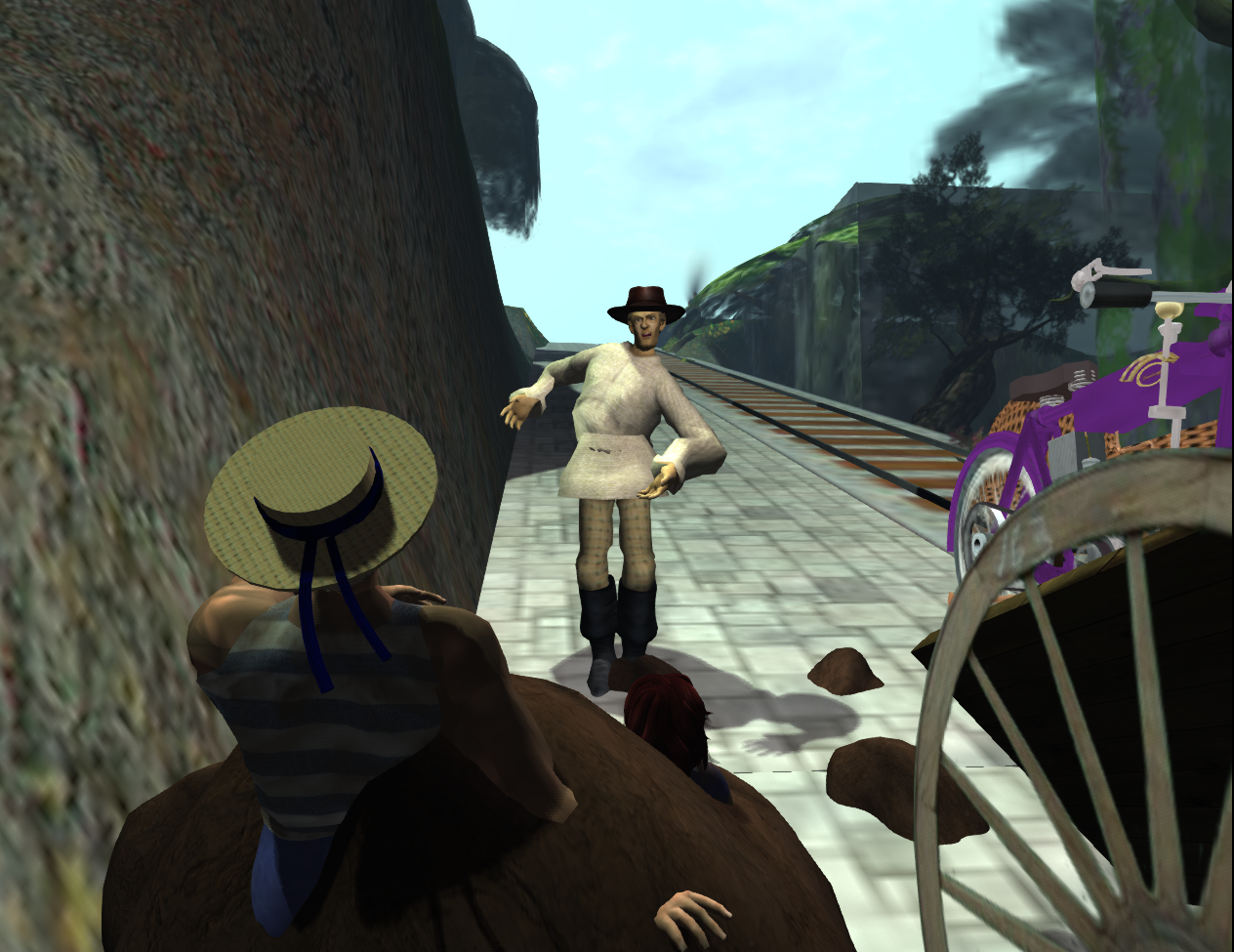
Choking, my reflexes took over and my reluctant hands clawed their way through hot stuff with the consistency of setting mud until my fingers scrabbled in clean empty air. I surfaced to find myself buried to the neck in thirty hundredweight of fresh, steaming horse residue, taking down great gasps of manure-laden air.


Beside me, a pair of legs jutted out. They flapped about a little, and then the whole side of the “cargo”  subsided as Mr Whybrow fought his way out of the pile, tumbling to earth in a brown lumpy avalanche. I tried to force my own way out upwards, which was the most natural direction, but with Mr Whybrow’s subtraction, my own movements made the whole lot collapse sideways. The poor man was still on his hands and knees, retching, when he found another quarter ton of ordure and shopgirl dumped on top of him.

We fought as much against each other as we did our imprisonment, but finally found ourselves sitting side by side, gasping for oxygen, and trying not to heave against the stench taking advantage of every necessary breath to invade our lungs and try to squeeze our stomachs like bellows.


A shadow fell across us. Mr Gongfermer himself, as livid as the devil incarnate. “Whaat the bloody ‘ell d’yew think yore a-doin?”  came the angry demand.

Mr Whybrow mumbled something about his bike, which was half-buried in the cart.


“Well, thass-a what comes of gallivantin’ abait on motorygadgits wot goes against the laws o’ nature. Messin’ up the labours of honest ‘ard workin’ folk. I spends all day keepin’ yer streets clean for yer, makin’ sure me load’s all noice ‘n’ toidy so it don’t spill ait over yer pavements, and wot do I get? Some pair o’ young tearaways scaat’rin’ it arll owver the bloody tain! Well, yew spilt it – yew can shovel it arll baack in again!”

Mr Whybrow and I exchanged a look in silent but disgusted agreement that that was only fair enough.  Like any well-organised public servant, Mr Gongfermer had a spare shovel, so we were spared having to argue over who was to do the heavy work. It was made worse by the fact that we had to pull out another half ton of cargo, just to free the Dreadnought from its clutches. From time to time, Ploppy treated us to a supercilious snort from alternate ends, and added to our workload in his own sweet manner.


Mr Gongfermer kept us at it until every last ounce of contaminant had been removed from the thoroughfare. Several times, we were about to hand back our shovels only for him to point at a minute speck on the road. “Look – yer missed a bit there!”  But finally, he was satisfied and set off to make his rounds of SouthEnd, leaving us with no great show of gratitude.

Mr Whybrow was more interested in the Dreadnought.  “Look at this. The shoes have been loosened at both ends; they’re all but falling right off.  Jasper,”  he pronounced, spitting his name like a bad taste to be got out of the mouth.

“I thought I saw someone near the bike while we were swimming, sir. A woman, certainly too thin to be Jasper. But she was tall, and in widows’ weeds. I think I know who she was.”


Mr Whybrow straightened up in disgust. “In that case, so do I. And the widows’ weeds are an excellent disguise. Near-complete anonymity, and who’d dare question a widow?”

“And let me guess,”  I completed. “The police would tell us that the brakes came adrift in the crash.”

“Correct,”  replied Mr Whybrow. “As much as I hate to ask you to do this, can you poke out the stuff jamming the wheels with a twig or something? I’ll need to hold her back while you do it, or she’ll drop straight downhill once she’s free.”

For the first time, I appreciated the Dreadnought’s weight as we held her back against gravity. Once we’d levelled out, though, the two of us were able to push the bike without much difficulty.

“Sir, if they’re prepared to go this far, aren’t you worried about them catching you at home, living alone as you do?”


Mr Whybrow shook his head. “My security’s second to none. If either of them appear anywhere near my house, they’ll find it a long way down.”  The grim set to his jaw told me that that was precisely what he was hoping they’d do.

We put the Dreadnought in the stable and stood looking sadly at it. I could guess who’d have to hose it down – the poor Dreadnought  smelt every bit as bad as we did. Our clothes were in the sidecar, and a sorry mess they were in, too. That lot wouldn’t just  “brush off when dry.”

“I’ll see to the brakes later on,”  Mr Whybrow decided. “Right now, I need to cleanse myself thoroughly.”

I understood, being in the same state myself.  “My kitchen pump is nearby, sir. Do feel free to use it.”

Mr Whybrow looked himself up and down, and grimaced. “As grateful as I am for your offer, I don’t feel I could sully anybody’s house like this. I’ve a better idea. Come with me.”

I followed him out to the quayside where he stood for a moment, studying the water. I saw at once what he had in mind. “On three. One – two – three!”

We both bolted for the harbour and jumped in, with Mr McKew gaping in disbelief from his shop window.


Ordinarily, we would not have dipped a finger into the harbour, but Mr Whybrow advised me that if his coffee grounds could kill teredo worm, then germs wouldn’t stand much of a chance either. And it had to be cleaner than we were.

We lingered in the shallows, purging our outfits as clean as they were likely to get. Of course, Mr McKew couldn’t help but be curious, and there was no lying our way out of it. I’d swear I’d never seen anybody laugh so much.


When we judged ourselves sufficiently presentable to the casual eye, we clambered out. I went home to put my costume in soak with a teaspoon of Jeyes’ Fluid; I then added the same to my bath water and treated myself likewise. I’d smell like a hospital, but it was better than smelling like Buckinghamshire. Anyway…………


I suspected that Mr Whybrow had done exactly the same. I was back in the shop, privately wondering what Jasper and Miss X were going to try next, when my master appeared, wearing an almost visible aura of Jeyes’.  He was carrying a sinister-looking object, which he presented to me.

“I meant what I said about the revolver,”  he told me. “I’m very grateful to Miss Creeggan for having taught you to use one of these. I want you to keep it handy at all times. If you have to use it, don’t worry about the law. The Postmistress saw what they were up to, so you have ample protection against punctilious jurors.”

I regarded his gift as though it would be more deadly to me.


“It’s a Webley .577,”  he explained. “Takes Boxer cartridges. You won’t be able to use the wrong ones, anyway; they’ll just fall out. Not good for range, but with any luck, just staring down the barrel will be enough to send someone running for their lives. One word of advice, though – don’t ever draw this on someone unless you mean to kill them. This thing won’t wound; a hit anywhere will ultimately prove fatal.”

I acknowledged him with a sober nod as I turned the revolver over in my hand. It was like a steel brick.

“And now, Miss – might I suggest a restorative, after a somewhat trying day?”

I didn’t really drink, as a rule, but I was not going to turn down his best brandy at ten bob a bottle. But Mr Whybrow had other ideas. “Thank you, sir. But only if you join me.”

“That was my very intention. There’s the small matter of coffee and liqueurs which we never got around to. I know just the place; very public – somewhere no assassin in their right mind would try for either of us. And don’t worry about the Dreadnought; it’s up and running, and perfectly safe.”

I’d have asked to use the Dreadnought anyway. You know, how when you fall off a horse you have to get straight back on again?

The Dreadnought itself seemed happy about our little outing. The engine gurgled evenly as Mr Whybrow took us across Downs and through Tamrannoch again. Moors, with its cemetery, hardly hindered the clouds that were lifting from my mind and when he took us through Victoria City, with its great emporia, I felt that I was being shown off with pride, although I don’t know exactly what as. Definitely more than a shopgirl, but not a companion in the usually-accepted sense of the term. Part of a family, perhaps?

When we entered Penzance, I wondered if Mr Whybrow was going to take me back to Kittiwick or Tanglewood, but he kept on going – no, not to the theatre, that wasn’t open yet.

Ah.

He pulled up outside the “Penzance Inn and Publick House.”  Mr Whybrow helped me from the sidecar and went to speak at the bar while I took in the establishment. It was a wonderfully cosy place so reminiscent of some of the better London pubs, with its posters, intimate nooks and button-leather chairs, but without the sawdust on the floors. It was as if he’d brought me home – home to the London that I should have known.


But what caught my attention was the open platform where one wall should have been, jutting out to sea. I guessed that it must be used for functions. Returning from the bar, Mr Whybrow briskly invited me, “It’ll take them a couple of minutes; would you care to dance until our order’s ready?”

Was this his way of trying to raise my spirits with a repeat prescription of Paris, or was he simply trying to bring home that what had happened there was no dream?  Either way, I was delighted to accept.


Mr Whybrow wisely plumped for a waltz again, this time keeping to a slightly slower, more floating tempo. Penzance was quiet, which helped me relax, although I don’t think I’d have cared if all Caledon had turned out to cheer us. We spoke little, preferring to bask in each others’ company, which in my case included floating with pride at being presented to the world as a lady. And the waltz, with his large hand settled on my waist, suffused me with reassurance that all was going to be well. This time I was used to the dancing, and it did not seem quite so surreal as it had in Paris, and I was able to let it work its medicine, and bask in the smile that he radiated down onto me.

“I don’t know if you’ve bothered calculating our position on the map of Caledon,”  he ventured. “But we’re in the extreme North-East corner.”

“The corner of the world?”  I returned, hoping that I sounded more clever than I felt.

“Our corner of the world,” he beamed back.  “Although I’ve no doubt we’ll find others, as well.”

“I like this one,” I reassured him. “London pubs don’t usually have dance floors out over the river, but otherwise I could be back in the West End. If my friends could see me now,” I mused, gazing at the ceiling.

Mr Whybrow responded with a chuckle which told me all. If his friends could see him now!

Our coffee and liqueurs were not long in coming, and he surprised me yet again by giving me a cigar. Not one of his huge phallic things, but a slim one which he told me was Dutch. I viewed it with suspicion at first, but it proved light and delicately fruity.


To go with my coffee, he’d ordered me a crème de menthe, which he assured me was “right for ladies.”  But honestly – wouldn’t you regard with suspicion when someone put a glass of something thick and green in front of you? But when I took that first experimental sip, my head exploded with comets of delicious minty coolness. It did me good to see him smiling with approval; I’d long had the impression that it meant a great deal to him, to see me happy at something he’d done.

This placated, Mr Whybrow relaxed and broke the silence to enlarge on how Caledon observed halloween, with a few stories about the amazing and grotesque things that the locals built, which made me laugh. I suspected that he wanted to distract me from our immediate problems, and I think he was right to do so, although I did hope that he didn’t keep me out too late. I’d put off getting my airship silk for long enough.

We took our time over our refreshment without dawdling, and left when the sun was still settling towards the horizon. I was glad I hadn’t bolted the crème de menthe; it was stronger than it tasted. As it was, it had worked hand in hand with Mr Whybrow’s personal ambience to smother me with a gorgeous narcotic balm as the Dreadnought carried us homewards at its own relaxed pace.

But the day had not finished with us yet. We were about to pull off the street into the stable when Mrs Boltclyster ran out; she must have recognised our engine beat.


Mr Whybrow slowed and let her catch up. “Hello there, Mrs B! What’s amiss?”

Mrs Boltclyster was slightly flushed as she gasped her reply.  “I just thought you ought to know, Mr Whybrow, there was some woman hanging about the shop.”

“I get them all the time,”  Mr Whybrow explained, with a grin of encouragement. “I sell them jewellery, remember?”

“Yes, but there was something not right about  this one. She was in widows’ weeds – I mean, how many women even window shop for jewellery when they’re in mourning?”  (“Quite,” murmured Mr Whybrow.)  “No, this one came in an old carriage with a driver, she got straight back in again and took off before I could get a half decent look.”

Mr Whybrow and I exchanged a suspicious glance at the mention of the widow. I looked over to the doorway. “Did she actually go in, or just stop off at the door? There’s a parcel there.”


“I suppose she must have,”  said Mrs Boltclyster. “I didn’t leave it there.”

“Just give us a moment to put the bike away,”  said Mr Whybrow. “And stay well away from my door. Miss Bluebird, stay with me.”

I went with him while he put the bike in the stable. I waited for him to switch everything off before asking. “Sir, something’s wrong, isn’t there?”

“In the light of recent experience, we have to assume as much,”  he told me, tersely. “I hope I’m wrong about this one, but if I’m right, you’ll appreciate why I didn’t want to hang around with three gallons of petrol between my legs.”

Thus deepening the mystery instead of answering it, he set off back to the shop at a wide gait I had trouble keeping up with. “Wait along the road with Mrs Boltclyster, will you?”  he told me.

I gave the postmistress a clueless shrug. As we watched Mr Whybrow approach the parcel, she gave me a wink, which I returned somewhat sheepishly. She’d recognised the crème de menthe  on my breath, and concluded that I was all right after my earlier ordeal.


We returned our attention to Mr Whybrow. He stooped low over the parcel, tensed his fingers on its sides as though trying to assess its weight without moving it, and then gently lifted it a couple of inches, to settle it again with the greatest of care.  Then he came over to us. “Addressed to the shop with no originating address, and the hand is a practiced one. It’s too heavy for gemstones or tools, too light for metal, and too solid for abrasive. More to the point, I’m not expecting any deliveries. Stay well back and make sure there’s always a wall between yourselves and me.”

“Oh, my Gawd,” murmured Mrs Boltclyster, but Mr Whybrow would not have heard it. He was already on his way back to the parcel.

“What is it?”  I hissed, afraid that my voice would bring about something dreadful.

“We think it’s a bomb, dear.”

Oh, my God!  Reflexively, I hastened to run after him, but Mrs Boltclyster’s steel fingers held me back. “Best let him do what he’s going to, dear. He knows what he’s doing.”

I watched, appalled and helpless, as he gingerly picked up the parcel and carried it around the corner with a deliberate, even step. Not until he was lost to sight did Mrs Boltclyster relinquish her grip on my arm, and we both scurried after him. We followed him as he carried the parcel across the harbour, drew back his arm slightly, and in a smooth arc, tossed it into the water.


Mr Whybrow threw himself flat but before he had hit the ground, a muffled thunder shook the cobblestones beneath our feet, and a voluminous spout rushed up from the sea. Mrs Boltclyster and I cringed under the salty spray that splashed us.


The explosion died almost as quickly as it had erupted. I opened my eyes to find Mr Whybrow clambering to his feet; he brushed imaginary dust from his lapels before marching back to us. In the background, the Sparkle and Old Stumpy were bobbing about at their moorings.

“I think we’ve solved the mystery,” he told us casually, as though it did not really matter.

Mrs Boltclyster looked from him to the harbour, where the water was settling back to its previous stillness. “I thought water was supposed to make them things safe?”

“Electric detonator.”  Mr Whybrow shook his head. “The water shorted it and set it off. I’ll have to check the ships to make sure nothing’s been strained, although they should be all right.” He did not sound entirely convinced as he looked at me. “It’s a very rare maid who knows how to build one of those things,”  he commented.

“You mean Jasper built it?”  Mrs Boltclyster demanded.

Mr Whybrow gave her a shrewd look. “That parcel was addressed in a practiced, fluent hand. Would you say he had a particularly elegant script, Mrs Boltclyster?”


“Never! He could read, but he could barely hold a pen.”

“Much as I’d have expected, then. Our maid comes with a very interesting pedigree. From now on, Miss Bluebird, whenever you go out, check over whichever vehicle you use for things that don’t belong there. If she thinks to incorporate a mercury tilt switch, it won’t even need the brakes to set it off.”

Mrs Boltclyster swallowed. “I think I’d better wire the Postmaster-General’s office. They’ll wanna know if one of their employees has run off the rails.”

“I wish them luck finding him,”  Mr Whybrow told her. “But I’m not sure they will.”

Together, we watched her stumble back to the post office. I could not help feeling sorry for her; I could see from the slight meander to her step that she herself felt partly responsible, purely by virtue of Jasper having worked for her.

“She must have planted that in case we discovered her monkeying with the brakes,”  said Mr Whybrow. “She’ll have known that we would have needed them on that gradient, but she had to allow for a train coming along and my taking evasive action.”  Then, now that he could be certain that we would not be overheard, Mr Whybrow turned to me and fixed me seriously with his eyes. “I’ve no right to expose you to this sort of danger,” he said quietly. “If you want to absent yourself from the area, I’ll understand, and I’ll help you in any way I can.”  For the first time, I saw real fear in his eyes. Fear that I would leave.

By now, I was no longer afraid of losing my position over what he’d once have seen as a liberty. I took his hand, interlaced five of his fingers with all ten of mine, and gave a firm squeeze as I met his gaze defiantly. “No, sir. I am staying for as long as you want me.”


Oooh, he looked such a twit at first! It didn’t take much to embarrass him, that’s for sure. But then he got a grip on himself and returned a curt little nod. “Thank you, Miss Bluebird. I don’t deserve you,”  he murmured as he headed off to check the hulls of Old Stumpy and Sparkle.

Well, I hadn’t expected a rhapsody. And I think he said it all in those last four words.


Thursday, 7 November 2013

The Last Post

No, not my  last post. There’s plenty more to come. No, what I mean is – oh, just read on. You’ll find out.

Yes, I’m afraid you’ll have to excuse me if that unexpected excursion has left me a trifle derangee. Please try to understand that when you’re used to – what, eighteen years of workhouse? I don’t even know how old I am, after all – anyway, if someone takes you out of that sort of purgatory, treats you how you imagine a princess would be treated, and one day you suddenly get kicked into one pit of depression after another, and that same man grabs you by the hand and sets you on a pedestal, it’s going to be just a little  bit distracting, isn’t it?

Anyway, where was I?  Oh, yes. Now, this, I really had not expected!

There seemed to be a strange intermezzo between my last memory of the Sumie  bringing me home, and the sudden hardness I found under my head. An ethereal, intangible carnival of images of the preceding day and evening, processing through my mind flowing merrily one into the other, none lingering long enough for me to focus on it. Most of them, my subconscious happily accepted as real, and I even believed I was there  going through it all all over again.

But no, I wasn’t. There was that hardness under my head. Not painful, and only uncomfortable because my neck was in an awkward position.  I became aware of the gently hovering tang of cigars and old leather – those of you who’ve been to one of those gentlemen’s clubs, where they fine you for talking, will know what I mean.

Tentatively, I opened my eyes. I was on a big leather sofa with a blanket over me. The room I was in was warm and cheery; I was bathed in the golden glow from the embers of a once blazing fire, and a couple of lamps. It resembled a smaller, comfier version of the shop.


“You’re in my house,” came Mr Whybrow’s voice from over my feet; he must have been waiting for me to stir. I shuffled up on my elbows, to find him slouched in a chair. He explained, “You fell asleep on the Sumie, and I couldn’t really search you for your house key, so I brought you home. You’ve been asleep the whole time.”

I noticed that my shoes had gone – no, there they were on the floor beside me, but the rest of my clothing was perfectly intact. He’d taken no unfair advantage of me, even when he could have done so – and I’m not sure I’d have complained had he done so. But he had not, and I’d not expect him to do otherwise.

Shuffling himself a little more upright, Mr Whybrow told me, “I’m afraid you didn’t make it as far as the coffee and liqueurs, but I’ll be delighted to rectify that at your earliest convenience. If you so wish, of course.”


Oooh!  Did he really expect me to say, “Forget it, Mister?”  Still semi-conscious, and feeling a little awkward at my unusual situation, I summoned up the confidence to tell him that I’d be delighted, of course. “But how did I get here?”  I had to know. “The last thing I remember was the airship.”  Which wasn’t strictly true. There was another, definitely surreal remembrance, but that had to have been a dream.

Mr Whybrow merely chuckled. “I wouldn’t worry about it. You don’t weigh much at all, even with the contents of a Paris restaurant inside you.”

Then it was no dream. He really had carried me through SouthEnd, singing that waltz we had danced to, but with words I could not understand. “Poussez, poussez, escarpolette, poussez pour mieux me balancer……”

“You carried me all the way here?”

“I couldn’t do much else! You’d left your house locked, and like I said, the key must have been on your person.”


The most terrible picture formed in my mind. I hardly dared share it with Mr Whybrow, but my mouth wasn’t dry and I didn’t have a headache, so it felt safe to ask, indirectly, “I wasn’t – taken ill was I, sir?”

To my relief, he laughed. “Good Lord, no. We hadn’t got onto the strong stuff, remember? You were just spent. Emotionally, physically, mentally – it was my fault, I suppose; I should have allowed for you having had a particularly trying day.”


Phew!

To spare us both further embarrassment, I said, “I don’t know how to thank you, sir. I’m glad that at least I didn’t take your bed.”

Mr Whybrow smirked. “Actually, you did, but I shouldn’t worry about it.”

I looked around what turned out to be a single chamber, resembling an antiquarian’s parlour. All that really stood out was some of his paintings on the walls, a huge harmonium at one end – well, did I expect anything else?  There was a peculiar sort of glass-fronted box on a side table, and a group photograph that intrigued me, but certainly no sign of a bed.

“Where did you sleep, then?”  I demanded, horrified at the truth I knew I was about to hear.

“Right here. Don’t worry, I know some folk would frown at us sharing a room, but that’s none of their business and if you can’t trust me by now, then you never will.”

“It’s not that!”  I expostulated. “You always sleep on a sofa, and you even gave that up to sleep in – in – a chair?”

Mr Whybrow shrugged. “What’s the problem with that? I’m used to it; sometimes I fall asleep in it if I’ve been sitting up reading.”


My unpleasant suspicion sank one rung lower. “Then – is this your whole house? All of it?”

Tiring of an argument he sensed he’d only lose, he braced his hands on the chair arms and forced himself up. “All of it. It’s served me well for a very long time. And I don’t expect either of us to think straight without coffee.”

“Well, at least let me build up the fire, sir.”  Suddenly, I was afraid of appearing ungrateful after the magical day he’d just given me.

But he had already disarmed me, by marching over to the harmonium of all things. “No need, I’ve had this on a low tickover for half an hour now.”

I scrunched up to a sitting position as I watched him twiddle a valve and the harmonium, which I then realised had been hissing gently in the background, spouted boiling water into a samovar.


He gave the samovar a gentle kick as though to dislodge a minor blockage, and tapped off two steaming mugs of coffee. It was strong enough to strangle, but one day in Paris had been enough to spoil my palate. Otherwise, I was used to his coffee by now. As I sipped, smiling appreciatively, I tried to think of the right words to thank him for the previous day, but nothing seemed really adequate. All the time, I had that nagging voice at the back of my mind, asking what he hoped to gain from it all, and each time, it was answered by Uncle Arthur’s advice, as true as ever. This time he seemed to be taking on the voice of Sherlock Holmes. I play the game for its own sake, Watson.. That still left me feeling awkward; it would have been easier to understand if Mr Whybrow had at least betrayed some romantic interest.

Inevitably, the time came for me to leave. My final thanks for his hospitality was somewhat more formal than I’d have preferred, but the depth of my gratitude must have shone from my face brightly enough even for him not to miss. I’d started to head for the door when he called me back – a little sharply, I thought.

“Not that way, Miss!”


“It’s quicker this way,” he told me with a smile, as he led me to a small back door which I’d missed.

I followed him back to the shop and as we parted in the street, he cut me a bow – I got the feeling that he was hoping the neighbours were watching.

“Thank you for being a superlative companion, Miss Bluebird.”

I returned the courtesy and beamed back.  “I do hope we can manage the liqueurs with our coffee next time, sir.”  It occurred me to slip a peck to his cheek, but I forebore. That would have changed the course of things entirely and I couldn’t be sure that it would be for the better. But he could not have missed the glow in my eyes as I departed for home.

When I exited to the street, the sun was peering curiously over the horizon at the slightly crazy shopgirl. I’m sure I must have been walking in an untidy wavy line as the images of the previous night sailed through my head, accompanied by that floating little waltz. “Poussez, poussez, escarpolette………”


I was still not entirely convinced that it had not been a dream, although the taste of the Chateaubriand rose above Mr Whybrow’s coffee, in my mind if not in my mouth, and my ankles were slightly stiff in a new and curiously exciting way, as a reminder of the dancing.

I never failed to be astonished at how highly he thought of me – not with romance and flowers, but in other ways, more original and profoundly personal. Despite all I’d learned, I still thought of myself as the workhouse unknown who’d been fortunate enough to land a position most would regard as menial. But Mr Whybrow saw only my mind, and what he could do for it.

While I changed into something better suited to the shop floor, I looked forward to taking every opportunity to insinuate to the customers that I’d been to Paris!  It had been the most romantic day imagineable, yet without a hint of actual romance. That was the one missing element, and I was not going to upset the equilibrium by chasing after something I could well live without anyway. Well, if it should  rear its ugly head, there was only one I’d consider – but I was not going to complain about its absence. Will that explanation suffice for now?


I remembered that that unexpected outing had scuppered my plans to collect my airship silk, but it was only put off for one night. I knew that its ‘owner’  had regular supplies coming in, which he sold on to the Bond Street couturiers, so I’d be very unlucky not to find enough for my purposes secreted away where he’d hoped nobody would find it. Right now it was more important to me that although I’d long felt like the face of Mr W’s establishment, this was the first time I felt like I merited that. He’d entertained and danced with me, like a lady. I was fit to look anyone in the eye.

I vowed to be careful to preserve my usual manner in dealing with customers, but I now had an unshakeable confidence behind me. And I did not have long to wait. Halloween was looming up, and Caledonians take that festival very seriously. Naturally, Mr Whybrow cashed in on      catered for these, so we had a steady influx of customers all after these specialised items.


Yes, I’d definitely acquired a more polished finesse as I showed the lady my pumpkins  our pumpkin ear pendants. (Dear me, that day in Paris definitely did  something to my faculty of concentration!)

“Do be careful to keep your hair away from them,”  I advised as I led the way to the cash register. “Even those tiny lamps can get very hot.”

“Oh, certainly,”  giggled the lady. “And at least the gentlemen will be able to find this dance partner in the dark!”

I treated her to a peal of laughter which, for once, I did not have to affect. For the first time, I could hear someone talk about dance partners without that visceral wrench of jealousy. I’d only had the one dance partner, but it had been the right one. “That’ll be a hundred, Miss. Do you have an account with us?”

“No, I’m new to the area. Will cash be all right?”

“Cash will be just fine, Miss.”

I rang up a hundred on the cash register, picked up the lady’s proferred banknote, and the drawer sprang open. And a familiar figure leered out at me from its partitions.

HARRY!


I don’t know which of us screamed louder. All my ladylike poise vanished like a celluloid moth in a furnace, but before I could utter a single expletive, the shop door banged loudly and where the customer had been, was a big empty Nothing.

Mr Whybrow emerged from the back office. “What on earth  was that all about?”

“Harry, sir,”  I explained, trying to jump up and down on my heartbeat to restore it to something more human.

“Where?”

I looked back to the till drawer. “He’s – oh. He’s gone now. But we both saw him.”

Mr Whybrow cast an amused eye about the now-empty shop, having understood instantly what had happened. “’We,’  Miss Bluebird?”

“Well, she was here – “  I realised that he was teasing me. And we both knew that Harry, having done his duty in upsetting the harmony of the shop, had vanished to laugh it off in private. “She left this banknote, sir, in payment for her pumpkin ear pendants.”

Mr Whybrow frowned. “She left her ear pendants behind as well,”  he observed. “Who was she, do you know?”


“I’m afraid not, sir. She said she’s new to the area. Oh, one moment!”  It came back to me. “She did say she’d moved to Caledon on Sea.”

Mr Whybrow nodded. “There’s only one place she can be living. Only one new resident’s moved into On Sea in months. If she doesn’t come back, you’ll have to deliver them when it gets quieter. You can use the Dreadnought, I’ll give you directions later.”

“Very good, sir.”

I sent a wistful smile after him as he retreated into his office and out to the yard. I was still very much His Shopgirl, but there was an unmistakeable softer, friendlier timbre to his voice when he spoke. I doubted he had any private intentions towards me, and from what he’d told me about his past, I’d have understood if he’d sooner lie in front of a train than take on another woman. It was enough that we had shared what we had. He’d even cast away his most closely-guarded privacy in my hour of need, and let me spend the night in his house. That alone had wrought a special sort of bond between us.

I took up the ring guage that I’d used to such effect the previous day, and searched around the counter area for Harry, with a view to discouraging his return. But I believe my prediction had been all too accurate. He’d scarpered, to savour my fright and plan the next visitation.

Or perhaps he’d been scared off by the curious hammering which had just started up in the yard. Sharp clinks of iron on masonry. I tried to sneak a peep, but Mr Whybrow had hung his coat on the other side of the doorknob.

Bother!


Thwarted, I returned to the counter to mull over another mystery. The outing had ended with a final surprise which I had not expected; I had seen Mr Whybrow’s house. On reflection, I had found it much as I should have expected; that is to say, calculated to soothe his senses yet without an ounce of domestic practicality. But he had been just a little too quick to divert me to the right door. Had he something to hide up there?

A familiar figure strode past the window, making his usual rounds. I entertained a minute hope that he’d use the letterbox, but that hope was very short-lived as Jasper marched in, his countenance stern and officious as he smacked the post onto the countertop.

“I looked in larst night, but the place was empty.”


I matched his frostiness with my own. “You were told not to come in again. And since you’re so observant, Mr Whybrow took me out. To Paris,”  I haughtily added.

Jasper’s face melted into – well, it reminded me of a failed throw of clay on a potter’s wheel. “Oh, gay Paree, was it? Sarfend too small for you now?”

Primly, I told him, “In matters of business, we have interests throughout the civilised world.”

“Business!”  Jasper snorted. “I knows wot your business is! You and ‘im ‘avin it orf in Gay Paree.”

Outrage flared within me. “It wasn’t like that! Not that it’s any of your business.”  I transfixed him with eyes of ice, too angry even to think of a jab to the throat. “I told you yesterday; we have a letterbox outside. Kindly use it. The master is fussy about whom he allows in. And he does know all  about you.”


His piggy little eyes narrowed in menace. “So someone’s bin tellin’ tales aht o’ school, ‘ave they?”

My immediate thought was that he must have been referring to that famous metaphorical School of Hard Knocks, but that unfortunate wording, associated as it was with what I’d seen, made me want to cringe. “He’s perfectly entitled to know what goes on around his own chapel.”

“Don’t come the innocent wiv me, Missy! I know yore game. I’m not good enough for the ‘igh and mighty shopgirl wot’s knockin’ orf ‘er master! Well let me tell you sumfink, Missy! I got an hofficial position ‘ere as a personage of himportance, not like you wot’s just someone’s personal sweeper-up. So I’s gonna be comin’ and goin’ according to ‘ow I pleases. And you ain’t gonna be doing nuffink abaht that. And don’t you be finkin’ of tellin’ the Postmistress abaht anyfink you saw behind the chapel, right? That’s private business.”

I was sure his allegation was made purely to try to shock me. It failed. I glared at him thinly. “You’re very protective towards your own privacy for someone who cares so little about mine. I think you’d better go. Right now.”

I reached under the counter for the cattleprod, which I knew to be there, but Jasper grabbed my wrist in a grimy grip of steel. A Hadean fug of beer and bad tobacco washed over me as he dropped his voice to a whispering rasp. “I don’t fink you quite understands my meanin’, Miss. I means to ‘ave wot I’s set my eyes on, and until that moment, I’s gonna be a-watchin’ you.”


I seethed with frustration at being unable to fetch him another kick, if only to organise a little distance from his breath. I now knew what those knew-fangled crematoria smelt like when they were in full flourish. But Jasper’s attention, focussed on me, had cost him dearly.  Suddenly his grip vanished and I flew backwards. Jasper was no longer looking quite so confident.

Mr Whybrow was standing in the doorway. I did not know how much he had overheard, but he had clearly taken in the whole situation. He was not a man given to losing his temper; he believed that “cold”  worked better than “hot.”  I’d seen him cold and dispassionate, I’d seen him cold and condemning, and I’d seen him cold and unforgiving, but I’d never before seen the dreadful mask he wore as he strode out, his eyes locked onto Jasper’s as he swung the little counter door open. He was an executioner come for his victim, and this time it was personal.


Jasper, realising that he’d probably need both hands, released me. “Now, don’t you  be a-takin’ any ideas into yore ‘ead, sir.”

He bunched his fists, but Mr Whybrow was faster. He moved too quickly for me to follow, I saw only his arm as a flashing blur connecting his shoulder to Jasper’s throat before Jasper doubled up with a ghastly gurgling noise.


Before Jasper could recover, Mr Whybrow reached behind his collar and gave a curious little twist. I could only gaze on in astonishment as he lifted the postman off the ground like a human gibbet, and marched evenly and unhurriedly towards the door, with Jasper roaring in agony. Or doing his best to; it sounded like a lion choking on custard.


Mr Whybrow paused only to ensure Jasper’s cooperation by slamming his face into the doorpost, before kicking the door open and with a final flick of his arm, sending Jasper sprawling into the gutter.

Jasper spat out some gravel, which may have had some teeth mixed in, and croaked, “You ain’t ‘eard the larst o’ me, Missy! I’s a gonna ruin you! I’s a gonna ruin you bofe!”

Mr Whybrow’s drawl reminded me of an army officer dissatisfied with a barrack room on Monday morning parade as he told Jasper, deliberately loudly for me to overhear, “My assistant instructed you to use the letterbox. She has a revolver, and if you step over the threshold again, she will presume personal attack and empty it into you. In the meantime, I think a letter to the Postmaster-general is in order. Now kindly **** off. You’re making the street look untidy.”


He knit his mouth to a tight slit as he marched back to me, straightening a collar that was already perfectly straight. I followed him with that same paralysed gape as I tried to absorb what had happened so suddenly – not least at the unaccustomed expletive, although I suppose Mr Whybrow’s own “’umble horigins”  were never too far below the surface.

Although I knew that none of his fury was directed at me, I took a pace backwards as Mr Whybrow returned behind the counter and looked grimly at me.  “It’s all right, Miss Bluebird. I heard the lot – the idiot didn’t even have the sense to keep his voice down. You handled it well, under the circumstances. I’m proud of you.”

With the immediate danger past, all that remained was an aftershock that fought to release itself in tremors throughout my body. Why on earth couldn’t he at least give me a hug?  I managed a shaky whisper. “Thank you, sir.”

“And I meant what I said about the revolver. He’s a nasty piece of work, Miss Bluebird. Keep an eye out.”

I flicked my eyes from Mr Whybrow to the heap on the pavement which was stirring itself; I could almost hear his joints creak. “But how did you – “

“Remove him?”  Mr Whybrow gave a snort which might, under other circumstances, have been humourous. “Never tangle with a portrait painter or a pianist, Miss Bluebird. We know the human nervous system as well as any doctor, in particular which ones are close to the surface. In the meantime, I’ll have a word with the Postmistress about our future delivery arrangements. That oaf’s position is hanging by a thread. And he’ll be hanging by his neck if I catch him in here again,” he added in a terse matter as he marched out to the post office.


I knew that Mr Whybrow was right. Jasper had not finished yet. If anything, his unceremonious expulsion would have made things worse. I was expecting trouble from that pirate-maid-woman, too. Her type always had to have the last word, and as she’d already been thwarted in securing Mr Whybrow’s affections, she had a double motive for revenge. It was only then that I realised I didn’t even know her name. Mr Whybrow had never volunteered it, and I’d always found other ways to refer to her. All right, I’d established that she was not exactly a pillar of the community, and was a scheming poser with some acting ability and no manners. But who exactly was  she?

Jasper did not return that morning. Well, there was a late morning delivery, but he wisely slipped it into the letterbox and continued on his way.

I waited until about two o’clock before concluding that the pumpkin ear pendant customer would not be coming back in any short order. At that time, the world would have returned to its after-lunch routine and I thought I could afford to leave the shop untended.

Putting the ear pendants in the Dreadnought’s sidecar, safely tucked under my skirts, I wheeled it out, set all the levers, and heaved it to bump-start it. The motor gave a disgusting coughing fit before catching, and I leapt into the saddle.

I braced myself for the bump over the railway lines, and absorbed the slight jarring with ankles and calves, as I was used to doing. What I did not expect was the front wheel to come clean off and dig the forks into the railway ballast, almost catapulting me over the handlebars. Luckily, I was always careful not to spin the throttle until clear of the railway, so I wasn’t going fast enough to follow the wheel and fly out of the saddle. I held on tightly as as the bike slewed round and sat there, patiently ticking over as though waiting for me to explain what the hell I was doing. The front wheel, on the other hand, bumped merrily along the street to be arrested by a hedge.


There was no way I could move the bike myself. Retrieving the front wheel, I took it into the shop and called through the door to Mr Whybrow, hoping I could make myself heard above the hammering.

“Mr Whybrow, sir? I’m sorry to disturb you, but there’s a problem with the bike.”

To my relief, the hammering stopped immediately. “Have you flooded it again?”

“No, sir. Uh – a bit fell off. I think you’d better come and see for yourself.”

The door flew open, but the glare of exasperation vanished from his sweaty face at first sight of my holding the front wheel out like a protective talisman.

“How the bloody hell did that happen?”


“I don’t know, sir. I hadn’t done anything to it, and it behaved perfectly the last time I used it.”

I think he believed me. “Are you  all right?”

I managed a wobbly smile. “Just a little shaken, sir.”

“As one would expect you to be. But you’re otherwise uninjured, which is what matters. I presume the Dreadnought didn’t get away so lightly?”

“The forks aren’t bent, if that’s what you mean, sir. I wasn’t going fast at the time.”

“No, of course not. Let me see that a minute.”  I had to step out of the way as he slipped through the door, locked it behind him (Dammit!) and grabbed the wheel from me, holding it to the light.

“Amateurish,” he pronounced. “Very amateurish. Look at the nuts – see those edges?”

I squinted. Yes, the sharp edges had been wrenched slightly round, and very recently. The metal was still shiny where it had been torn.


Mr Whybrow assumed that I’d found what I was supposed to be looking for. “The silly bugger’s used an adjustable spanner and didn’t keep it tight,”  he explained. “It’s wrenched at the corners. And see the oil in the threads? He used that to try and loosen it up when it wouldn’t turn as easily as he’d hoped.”

“’He,’ sir?”

He returned my innocently questioning look with one of thin patience. “This didn’t happen by itself. I think we both know who’s responsible.”

I suppose I’d known it; I’d just wanted to hear it confirmed from an independent mouth. Dumbly, I twiddled the nut on its threads; it slid easily. Far too easily, thanks to the oil. “So he meant what he said,”  I murmured.

“Aye. I’d been hoping he was all mouth, but it looks like our postie is serious.”

“So what are we going to do, sir?”

“Be patient,”  came the grim reply. “Don’t mention this to anybody. We can’t prove he did this, and any court in the land would accept his inevitable plea of shoddy maintenance on our part.”

“But we know – “

“Quite, me dear. But you know how the law operates. We need proof. Give me a hand to get that thing back into the stable; I’ll give it a new nut and you can take it out later if Miss Ear Pendant doesn’t come back before then. In the meantime, be very careful.”

He held the bike up to let me jam the wheel back into its forks, and together we pushed it back to the stable, where I donned my skirts. It didn’t bother me that Mr Whybrow was in the room while I did so, he’d already seen me wearing less, and it was not the time for excess modesty. Besides, he was preoccupied cluttering about for a spare nut, so I doubt if he’d have cared had I stripped to a state of nature.

I was, as I’d explained, more shaken than anything else. But I did need to give some thought to the future – I suspected that Mr Whybrow was already doing that himself while putting the Dreadnought back together. I thought I’d find the chapel more amenable. Those two ragamuffins might have left a stain on the atmosphere, but it was still a place of meditation, especially with Uncle Arthur’s presence watching over it.

When I walked in through the door, my eyes naturally turned towards Uncle Arthur’s tomb. They just had time to pick out another shape in the corner, which did not belong there, when a vast meaty hand clamped over my mouth and I found myself smothered in that unique mixture of gorilla armpits and “incinerated sacks” breath which I recognised instantly.


A growl, menacingly soft, tickled my ear, making me squirm, but I was held fast. “Yer master ain’t ‘ere now, Missy!”

As he spoke, his paramour stepped out of the shadows, gloating at my helplessness. Jasper’s hand prevented me crying out – or singing, come to that. I tried a backward heel kick, which had served me well in the workhouse, but Jasper must have spent some time in the same workhouse, for he was wise to the move, and stood with his legs apart and firmly planted.


The erstwhile pirate lady, now a maid, stretched her smile a little wider and tweaked my cheek. “So I’m not good enough for your high and mighty master, while his shopgirl  is.”  She spat my title out like poison. “And you humiliated me.”

Jasper’s murmur made me shiver more than that woman ever could. But I wouldn’t expect him to be speaking normally, after what Mr Whybrow had done. “You yoomiliated bofe of us, Missy. And it ain’t nice to disturb a gennelman at work.”

I began to wonder what they had in mind for me. Only a few ideas came to mind, and none of them were good. I tried to bite Jasper’s fingers, but he’d spread his hand too widely.

“So you would, would you, vixen?”

I felt him tense to do something that would no doubt be very painful. But that was as far as he got. There came a dull metallic bonggggg!  and his grip relaxed. I almost fell on top of him while the woman stepped back, aghast.


Framed in the doorway stood eighteen stone of bottled fury that could have silenced a Seven Dials brawl. Mrs Boltclyster, our Postmistress, clutching a frying pan as one would a tennis racket, and as terrible as an archangel who’d been dragged out of bed at three in the morning to deal with a minor nuisance.  I remarked that her frying pan would need some attention from the blacksmith before she could use it again.

“Your services are no longer required as of now,”  she growled to Jasper, with a dreadful simple finality. “And as for you, Miss - I can see that you’re no Easterman maid, and you can be sure I’ll be watching for you. I miss nothing from the post office. Show up here again, and I’ll have you picked up as a vagrant. Come with me, Miss Bluebird; let’s get you back to the shop. Those two won’t be bothering you again.”

Numb from shock, I barely registered the kindly tweak to her face as she shepherded me out of the chapel, with only a residual memory of Jasper sitting up, cross-eyed from the clout he’d received, while his companion stood mortified at having been caught out again. But I could feel the evil of her glare lancing through my back as I was led across the street. I felt that the Postmistress was underestimating those two.


Mrs Boltclyster could see that I was in no state to do anything but gape. She let out a bellow which normally would have paralysed me at such close quarters.

“Mis-ter WHY-brow!”

He must have recognised her voice and surmised that there had been further developments, for he appeared in the office door like a jack-in-the-box. He looked first to me, then to my saviour, and then back to me again. “Miss Bluebird? Whatever’s happened? Are you all right?”

Several possible explanations tried to surface, but my overloaded nerves jumbled them all up and all he got from me was a sheepish slanted rictus. The Postmistress had to speak for me.

“It were that Jasper again, sir,” explained Mrs Boltclyster. “Him and his ladyfriend – although ‘lady’ is a bit generous for the likes of ‘er. They attacked Miss Bluebird in the chapel. Don’t worry, they didn’t get very far. I thought he’d been gone a bit long for a simple call of nature like he said he was going for, so I went looking for him. And in the light of what you’d told me, I went prepared.”  She flashed her frying pan by way of explanation.

Mr Whybrow took two steps towards me and hesitated, not sure how to approach me. In the end he let his horror speak for him. “Good – God – Al-Mighty!”

“I can only say ‘ow sorry I am, Mister Whybrow,” continued our Postmistress. “We’ve had a cosy relationship for years, you an’ I, and I won’t let it suffer. He was already on a final warning; I told ‘im that if he came in here or otherwise went near you for any reason, he’d’ve been for the chop.”  She gave my arm a squeeze for reassurance. “Well, now he’s cooked his goose well and truly, and you make no mistake about that.”


Mr Whybrow could only nod. He looked to be torn between utter disbelief, and an urge to hunt down Jasper with a sabre. Finally, he found his senses.  “Thank you, Madam. I’m greatly in your debt at having stepped in like this. I’ll see to her now.”

Mrs Boltclyster gave me a wink. “You look after ‘er, sir. She’s a good girl, she is.”

“Oh, don’t I know it. Come on, Miss Bluebird.”

I let him lead me by the arm into his back office where he sat me in his chair and poured an inch of something dark brown into a glass. I took a swallow without thinking, and almost choked.

“Steady now, that’s best smuggled brandy at ten bob a bottle,” he grinned. “I gather our Postmistress turned up before things had got too out of hand?”

“They were out of hand enough already, thank you, sir,”  I mumbled. He’d left the office door slightly ajar, but I only saw rubble lying about.

“I’m sorry I wasn’t around to be of any use, myself,”  he said, with a helpless wave of his hand.

“It’s all right, sir. I couldn’t expect you to be.”


“Well, it looks like we’ve underestimated those two. What I’d like to do is go after him and put a bullet in him, but they’ll have gone to earth by now. We won’t see either of them until they’re ready to do something unpleasant.”  Then his expression lightened to one of hopefulness. “Might I suggest a change of air?”

I looked back, silently asking what he had in mind.

“Those pumpkins need delivering. The Dreadnought’s all right now, so why don’t we go and do that? Together? There’ll be no rush back, I’m sure things here can take care of themselves.”

He was right. A change of air would be the best medicine. In fact, a change of skin, or near to it. I projected a hopeful look at Mr Whybrow. “How long were you thinking of staying out, sir?”

“As long as we both feel like,”  came the answer, easily. “Did you want to bring your swimming things?”

I brightened instantly. I’d swear he could read my mind. “I’d love  to, sir!”

“Good,”  he declared. “I was of the same mind. I’m knackered!”